
Why Qatar Pays Fifty Five Million Dollars A Year To Host A Single Formula 1 Race Weekend
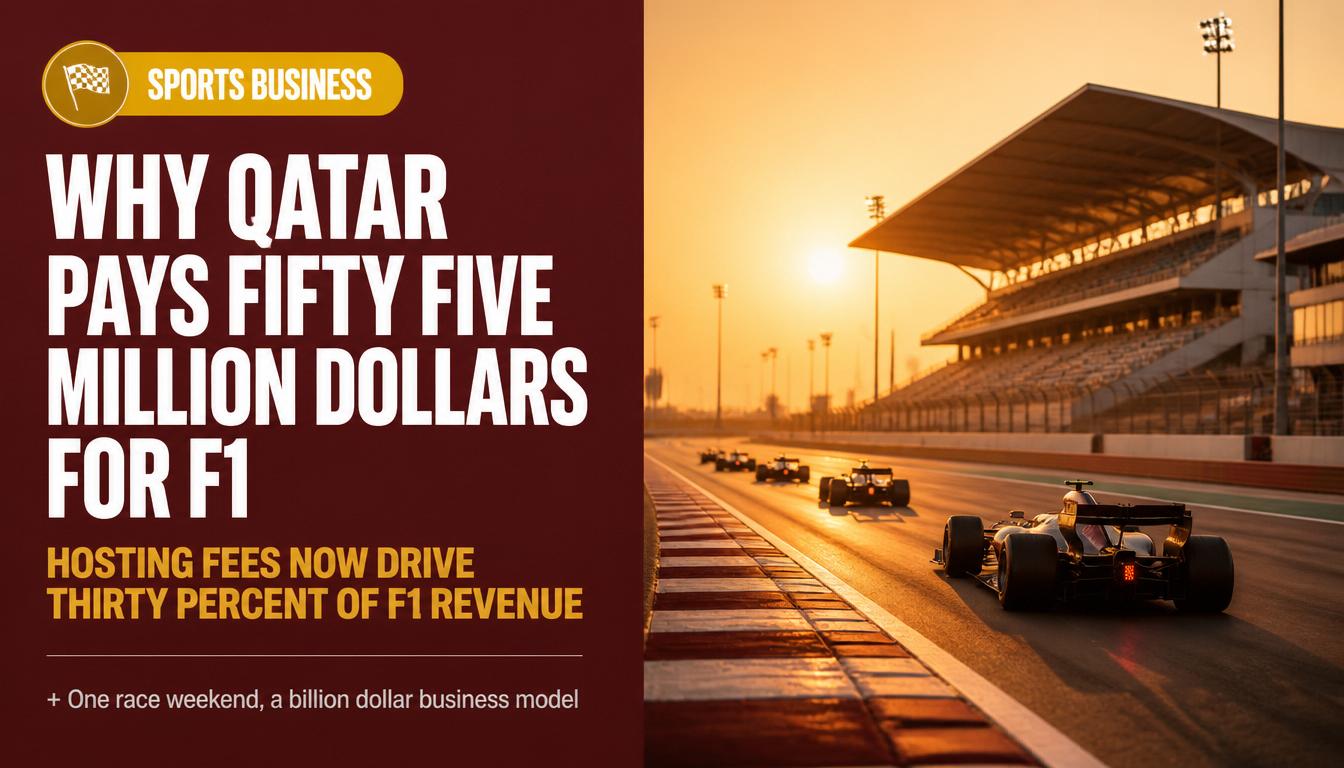
Formula 1 charges Qatar fifty five million dollars a year for the right to host a single race weekend, and the desert nation happily pays it, revealing a business model where hosting fees now outweigh ticket sales as the sport’s real prize.
Highlights:
- Qatar pays roughly 55 million dollars a year to host its Formula 1 Grand Prix
- Race hosting fees now contribute close to 30 percent of F1’s total annual revenue
- F1 generated a record 3.65 billion dollars in total revenue in 2024
- Monaco, F1’s most prestigious race, pays only about 20 million dollars a year
- Hosting fees can range from 20 million dollars to 55 million dollars depending on the circuit
Every time a Formula 1 car screams past a grandstand, there is a much quieter number sitting behind the noise, a cheque that the host country wrote long before a single ticket was sold. Qatar’s is the largest on the entire calendar.
Qatar pays approximately 55 million dollars every year simply for the right to host a Grand Prix weekend at its Losail International Circuit, under a ten year agreement running from 2023 to 2032. That figure places it at the very top of F1’s hosting fee table, tied with Saudi Arabia and Azerbaijan, and it is a useful entry point into understanding what F1 actually is as a business, a sport where the race itself is almost secondary to the commercial machinery running underneath it.
The mechanics of how this works are fairly straightforward once you see them laid out. Formula 1’s commercial rights holder, Liberty Media, does not simply let circuits host races for free in exchange for ticket revenue and prestige. Instead, it charges what the industry calls a race promotion fee, a fixed annual payment that buys a spot on the 24 race calendar for a season.
These fees vary enormously depending on the circuit’s history, location, and negotiating leverage.
Monaco, the sport’s oldest and most prestigious race since 1929, pays only around 20 million dollars a year, a discount effectively bought by decades of glamour, tradition, and a circuit F1 cannot afford to lose. Newer entrants get no such discount.
Qatar, Saudi Arabia, and Azerbaijan, all relatively recent additions chasing global visibility rather than motorsport heritage, pay close to 55 million dollars annually, nearly three times what Monaco contributes for a race with far less history behind it.
The broader financial picture makes it clear why circuits are willing to pay this much. Formula 1 generated a record 3.65 billion dollars in total revenue in 2024, a 6 percent increase over the previous year and more than double the 1.78 billion dollars the sport earned in 2017, when Liberty Media completed its acquisition. Race promotion fees alone contributed roughly 29.3 percent of that total, translating to more than 1 billion dollars flowing to Liberty Media annually just from calendar access fees across the 24 circuits.
That is money collected before a single hospitality package, broadcast deal, or sponsorship arrangement is even factored in.
For host nations, the return on this investment is not measured in ticket sales, which rarely cover the hosting fee on their own. It comes from tourism, hotel occupancy, international media exposure, and the kind of global visibility that traditional advertising campaigns struggle to replicate at any price. Qatar, like Saudi Arabia and Azerbaijan, is using Formula 1 as one instrument in a much larger strategy of positioning itself on the global stage, alongside investments in aviation, tourism infrastructure, and sports hosting more broadly.
This calculation has become considerably more urgent given recent disruptions to the calendar. Regional conflict in the Middle East forced the cancellation of both the Bahrain and Saudi Arabian Grands Prix earlier this year, a disruption industry analysts estimated could cost Formula 1 as much as 200 million dollars in lost revenue once promoter fees, sponsorship, and media rights are all accounted for.
Saudi Arabia reportedly pays in the region of 55 million dollars annually, just above the roughly 52 million dollars Bahrain contributes, and together these two contracts alone represent some of the most lucrative deals on the current calendar, both locked in until 2030 and 2036 respectively.
The fact that a regional conflict serious enough to cancel two Grands Prix barely dented F1’s overall commercial confidence says something about how deeply embedded these Middle Eastern contracts have become in the sport’s revenue base.
It is worth being clear eyed about what this arrangement actually represents, rather than treating it as a simple story of wealthy nations vanity spending on a hobby. The economics here are mutually reinforcing rather than one sided. Formula 1 benefits from guaranteed, contractually locked revenue years in advance, insulated from the unpredictability of ticket sales or weather at any single event. Host nations benefit from a globally televised platform reaching hundreds of millions of viewers, at a cost that, for oil wealthy Gulf states in particular, is a comparatively modest line item against the scale of their broader economic diversification ambitions.
The uncomfortable question underneath this arrangement is what it does to the sport’s older, more historic venues. Circuits like Spa Francorchamps in Belgium or Silverstone in Britain carry decades of racing heritage that money alone cannot manufacture, yet they increasingly find themselves negotiating shorter, less secure contracts precisely because they cannot or will not match the fees newer entrants are prepared to pay. Belgium’s Grand Prix has repeatedly signed only single year extensions in recent seasons, a stark contrast to the ten year certainty Qatar purchased outright.
There is also a fair question about sustainability once the initial novelty of hosting F1 wears off. Countries entering the calendar for the first time tend to generate outsized attention and tourism interest in their debut years, but that effect naturally diminishes over time as the race becomes a familiar fixture rather than a novel spectacle, even as the hosting fee itself typically continues climbing with each contract renewal. Whether Qatar’s tourism and visibility returns continue justifying a 55 million dollar annual outlay a decade from now, once the current contract approaches its 2032 expiry, is a question that will only be answered by how durable the country’s broader economic diversification strategy proves to be, independent of Formula 1 itself.
What this reveals, ultimately, is that Formula 1 has quietly transformed from a sport that host cities competed to attract, into a commercial product that effectively auctions calendar slots to the highest bidder among nations with both the wealth and the strategic appetite to pay for global visibility. That is neither purely cynical nor purely admirable, it is simply how the modern business of Formula 1 actually works, and Qatar’s 55 million dollar cheque is one of the clearest windows available into that machinery.