OpenAI Closes $122 Billion Funding Round at $852 Billion Valuation Backed by Amazon Nvidia SoftBank
OpenAI just closed the largest private financing deal in Silicon Valley history. Behind the record numbers sits a company burning billions, racing toward an IPO, and trying to hold together a founding mission and a commercial empire at the same time.
In November 2022, OpenAI released ChatGPT to the public, expecting a few thousand researchers and curious technologists to give it a look. A million people signed up in five days. A hundred million in two months. The product had touched something that no technology had touched in quite the same way before: the feeling, for an ordinary person sitting at a keyboard, that the machine genuinely understood them. That moment planted a seed that has since grown into one of the most extraordinary financial stories of the decade. On March 31, 2026, OpenAI announced it had closed a $122 billion funding round at a post-money valuation of $852 billion, the largest private financing deal in the history of Silicon Valley, and one of the largest capital raises any private company has ever completed anywhere in the world.
To understand what this round actually represents, you have to understand the company that raised it. OpenAI was founded in 2015 as a nonprofit, with the stated mission of ensuring that artificial general intelligence benefits all of humanity. Its founding team included Sam Altman, Greg Brockman, Ilya Sutskever, and Elon Musk, all of whom believed that the development of transformative AI was coming and that it was safer to have safety-focused researchers at the frontier than to leave that ground to commercial labs. The nonprofit structure was deliberate. The idea was that OpenAI would not be beholden to shareholders, quarterly earnings, or the pressure to commercialise at the expense of caution. Then reality arrived. Building frontier AI models requires compute at a scale that consumes billions of dollars a year. The nonprofit model could not keep pace. Microsoft invested $13 billion over several years, Altman restructured the organisation into a public benefit corporation with a nonprofit parent, and the company became, by any practical measure, one of the most commercially aggressive technology companies on earth. The $122 billion round is the punctuation mark on that transition.
The mechanics of the round are worth reading carefully, because not all of this money is what it looks like at first glance. Amazon anchored the round with a $50 billion commitment, but $35 billion of that is conditional. It will only be released if OpenAI completes an IPO by the end of 2028 or achieves AGI, two milestones that are not guaranteed and are not fully within OpenAI’s control. SoftBank committed $30 billion, with payments structured in tranches across April, July, and October 2026. The company secured a $40 billion bridge loan on March 27 to backstop the first tranche before the round formally closed. Nvidia’s $30 billion contribution is largely in the form of dedicated GPU compute capacity rather than cash. So the amount of immediately available, unrestricted capital in this round is significantly smaller than the headline number suggests. Analysts estimate that approximately $25 billion is confirmed as immediate cash: $15 billion from Amazon and $10 billion from SoftBank’s first tranche. The rest follows milestones, schedules, and outcomes. The round also included $3 billion raised from individual investors through bank channels for the first time in OpenAI’s history, participation from Andreessen Horowitz, D.E. Shaw Ventures, T. Rowe Price, TPG, Sequoia, BlackRock, and Blackstone, and continued support from Microsoft, whose total investment in OpenAI now exceeds $13 billion.
What does OpenAI look like commercially at the moment it closes this round? It has 900 million weekly active users on ChatGPT and more than 50 million paying subscribers. Monthly revenue stands at $2 billion, a figure that grew from $1 billion quarterly at the end of 2024. Enterprise customers account for more than 40% of that revenue, which matters because enterprise contracts are stickier, higher-margin, and more predictable than consumer subscriptions. The company says it is growing revenue four times faster than Alphabet and Meta did during their respective breakout periods. Those are genuinely impressive numbers. They also exist alongside a financial reality that the company does not hide: OpenAI projects cumulative losses of $115 billion through 2029 and does not expect to reach cash flow positive status until it reaches $125 billion in annual revenue, a milestone it does not anticipate until the same year.
The capital will go toward three things. First, compute: chips, data centres, and the infrastructure required to train and run increasingly large AI models. OpenAI has committed to spending across six cloud providers and four chip manufacturers simultaneously, a diversification strategy designed to reduce dependency on any single supplier as competition for compute intensifies. Second, Stargate: the $500 billion joint data centre venture announced in January 2026 with SoftBank, Oracle, and the backing of the US government, which aims to build AI infrastructure at a scale that no single company has attempted before. Third, the unified AI superapp: a single product that would combine ChatGPT, Codex, and agentic AI capabilities into one interface, which OpenAI has described as a major development priority for 2026 and beyond.
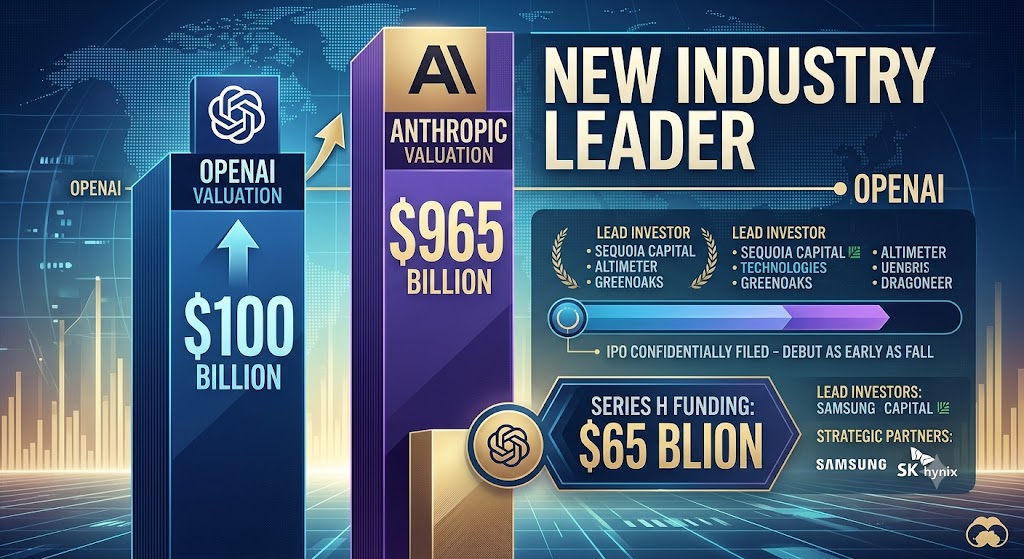
The IPO is no longer a distant rumour. OpenAI has confidentially filed an S-1 with the SEC, the formal first step toward a public listing. Sam Altman has said the company is open to going public at the right time. The conditional nature of Amazon’s $35 billion tranche, explicitly tied to IPO completion by 2028, is the clearest sign yet that investors are not simply waiting patiently. They are applying structured pressure. Most analysts expect a listing in late 2026 or early 2027, with reported estimates placing the IPO valuation approaching $1 trillion. Legal obstacles remain: the conversion of OpenAI from its current public benefit corporation structure to a conventional for-profit entity requires the approval of the nonprofit board, negotiations over Sam Altman’s personal equity stake, which is reported at approximately 7% of the new entity, and a sign-off from the California attorney general. None of these are insurmountable, but none of them are settled either.
The story of OpenAI is one of the most genuinely fascinating in contemporary business, not because of the money, but because of the question buried inside it. The company was created to ensure that artificial general intelligence benefits all of humanity. It is now valued at $852 billion, burning billions a year, backed by Amazon and SoftBank, and rushing toward a public markets debut. Those two things are not necessarily in conflict. Building transformative technology at the frontier costs extraordinary amounts of money, and commercial success can fund safety research in ways that grants and donations cannot. But the tension is real, and it will only intensify as public market investors bring their own expectations about margins, growth rates, and quarterly performance to a company that was built to operate on a different set of principles. OpenAI has raised $122 billion to win a race it defined. Whether it can win it on its own terms is the question that will define the next chapter.