
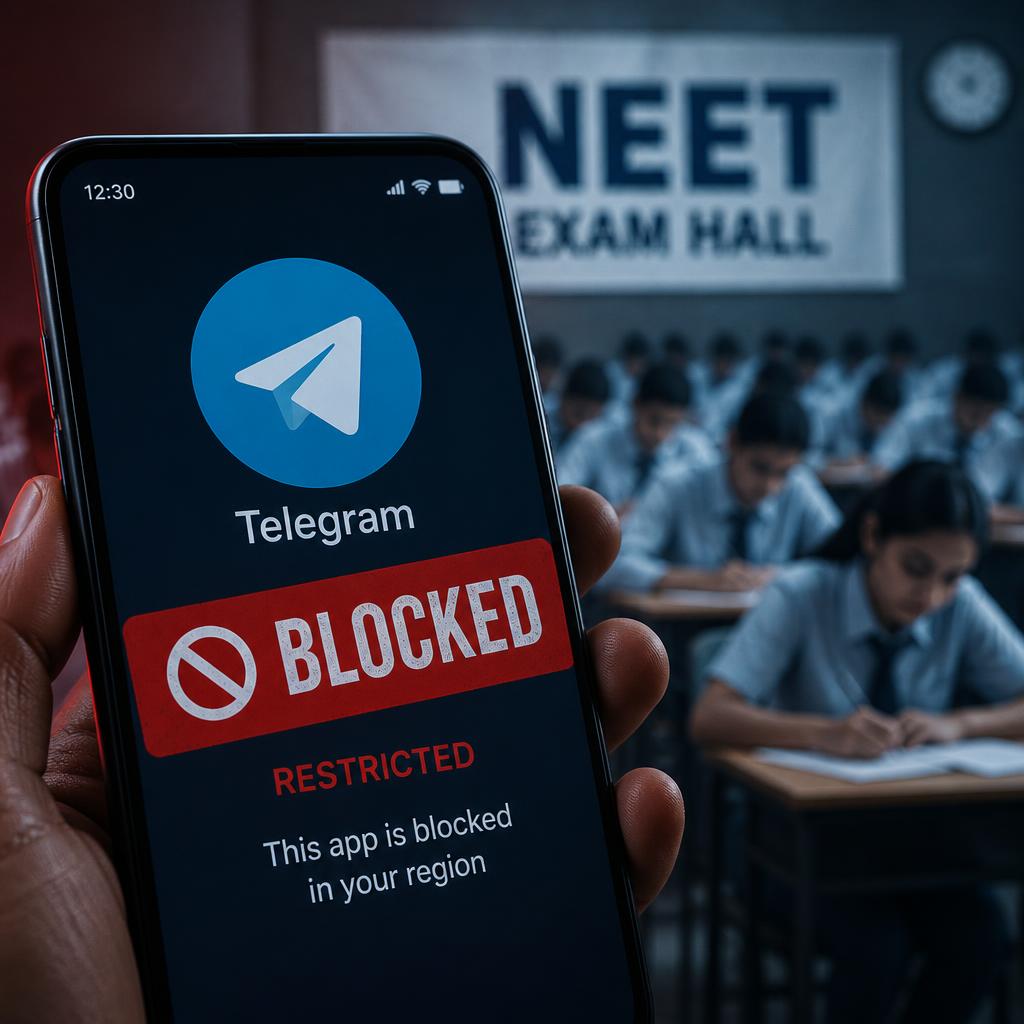
India Blocks Telegram Until June 22 Ahead of NEET UG 2026 Re-Exam Over Cheating Rackets
In an unprecedented platform-level intervention, the Union government has restricted access to the messaging app after cheating rackets used it openly to defraud medical aspirants, calling the step a last resort after channel-level takedowns failed.
The Indian government has done something it has never done before at this scale in the context of a national examination: blocked an entire messaging platform to stop fraud from spreading before the exam even begins.
The Union government restricted access to messaging app Telegram until June 22 to prevent cheating rackets from defrauding candidates ahead of the NEET UG 2026 re-examination on June 21. The directions were issued under Section 69A of the IT Act, 2000, based on recommendations from the National Testing Agency.
The context behind the block requires some understanding. The original NEET UG 2026 examination was held on 3 May 2026 for over 2.27 million aspirants seeking admission to undergraduate medical and dental courses. It was cancelled on 12 May 2026 following investigations that revealed overlaps between a pre-circulated guess paper and the actual question paper. The case was subsequently transferred to the Central Bureau of Investigation.
The re-examination is now scheduled for June 21. But before it could be held, cheating rackets were already active on Telegram, using channels with names such as “PAPER LEAKED NEET”, “Re-NEET 2026”, “Private Mafia”, and “REE NEET MAFIAA”, allegedly asking students and families for money ranging from a few thousand rupees to several lakhs.
The NTA said the measures were taken in the interest of public order in response to the organised use of Telegram by cheating rackets. The agency described the directions as a last resort after intermediate remedies, including channel-level takedowns, had not produced the required platform-level response. The Indian Cyber Crime Coordination Centre, under the Ministry of Home Affairs, coordinated the operational response, acting on inputs from the NTA, state police forces including those of Bihar, Gujarat, and Rajasthan, and its own monitoring of public channels.
Beyond the access block, there is a second, technically more specific order. A separate direction requires Telegram to disable the message-editing feature in India for messages already posted, until June 30, 2026. The reason for this is not immediately obvious, but the NTA explained that the editing feature had been used in earlier cases to change old Telegram messages after an exam. An old message could be edited to add a question paper later, with the original timestamp still visible, making fake leak claims look real.
That is a clever exploit, and the government’s response to it is equally precise. By disabling retroactive editing rather than only blocking new content, the order specifically targets the mechanism through which fraud evidence is manufactured, not just distributed.
The broader story here is the pattern. India’s most consequential national examination has now faced controversy in consecutive years, the cheating ecosystem has grown more organised and more technologically sophisticated, and the government’s response has escalated from targeted takedowns to full platform restrictions. What this episode reveals is not just the scale of the cheating industry but the limits of a piecemeal response to a structurally embedded problem. Blocking Telegram for six days addresses the immediate symptom. It does not address why the examination system remains vulnerable enough that two million aspirants must repeat a cancelled exam, or why the channels conducting the fraud are able to recruit enough paid users to keep appearing even after mass takedowns.
The re-examination proceeds on June 21. The deeper examination of how India protects the integrity of its most critical competitive tests is still ongoing.