
Meta Launches Muse Image AI Model Inside Instagram And WhatsApp To Compete With OpenAI And Google
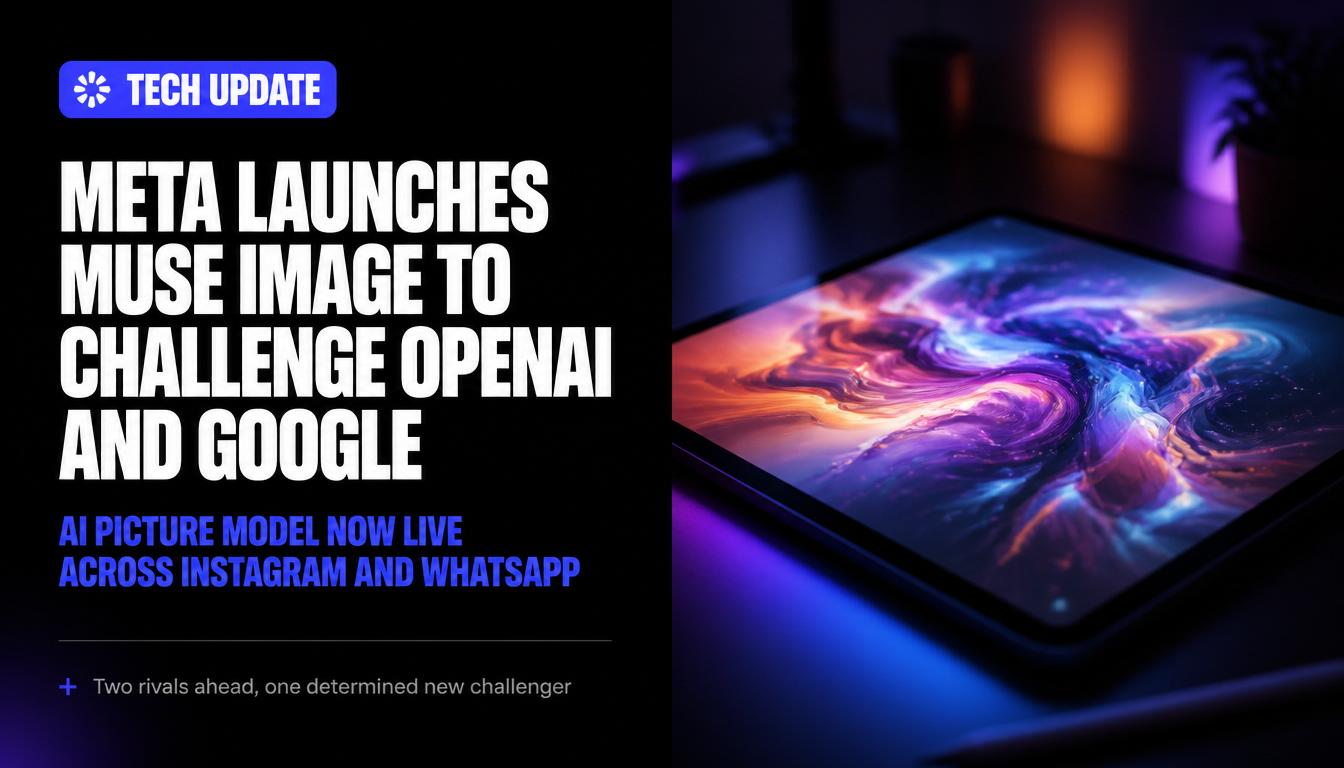
Meta has released Muse Image, its first in house picture generating model, betting billions of daily Instagram and WhatsApp users will help it claw back ground from OpenAI and Google in the fast moving race to dominate AI powered creativity.
Highlights:
- Meta has released Muse Image, its first in house AI picture generating model
- The tool lives inside Meta AI and now powers over 30 new Instagram Stories effects
- Meta says the model beats Google’s Nano Banana 2 but trails OpenAI’s latest image tool
- The launch ends Meta’s reliance on third party tools like Midjourney for image generation
- Muse Image will soon power ad creative tools for advertisers through Meta’s Advantage Plus
For the better part of two years, Meta has found itself in an unusual position for a company its size, playing catch up. While OpenAI’s ChatGPT and Google’s Gemini apps captured headlines with impressive image generation tools, Meta had been quietly relying on licensed technology from outside partners like Midjourney and Black Forest Labs to power the picture making features inside its own apps. That changed this week. Meta has released Muse Image, the first image generation model built entirely by its own Meta Superintelligence Labs division, marking the company’s most direct attempt yet to close the gap with rivals it has spent the better part of a year publicly worrying about falling behind.
Muse Image was originally developed under the internal codename Mango, and it arrives as the second major release from Meta Superintelligence Labs, the AI division Mark Zuckerberg set up after growing frustration that Meta’s earlier models were lagging behind competitors on reasoning, coding, and multimodal tasks. The lab is led by Alexandr Wang, and its first release, a reasoning focused language model called Muse Spark, arrived back in April. Muse Image is built specifically for visual content, and it lives inside the Meta AI chatbot, where it responds to plain, conversational descriptions rather than requiring the kind of precise, technical prompt engineering that older image tools often demanded. Users can describe a scene from nothing, hand the model an existing photo to edit, or blend several separate images into a single new composition.
The way Meta has chosen to roll out Muse Image says almost as much about its strategy as the model itself. Rather than launching a standalone app the way some AI labs have done, Meta is folding the technology directly into products that already have billions of daily users. On Instagram, Muse Image now powers more than 30 new AI effects inside Stories. On WhatsApp, users in select countries can generate images directly inside their chats with Meta AI, with more regions expected to follow soon, and Facebook and Messenger are next in line for the rollout. This distribution first approach is very much the Meta playbook, the same one it has used for years with features that began as standalone experiments before being pushed out to its enormous existing user base all at once.
Underneath the consumer facing rollout sits a fairly ambitious technical design. Muse Image is built to work alongside Muse Spark, with the reasoning model helping plan out a composition before Muse Image actually renders it, a process that lets the system pull in real time information from the web and call on search or coding tools to produce things like legible text, working QR codes, and detailed infographics inside a generated image, tasks that have historically tripped up most image generation models. One particularly interesting quirk that emerged during the model’s training is a kind of self correction behaviour that Meta says it did not explicitly design. During reinforcement learning, the model began reflecting on its own output within its own chain of thought, sometimes making a small local edit when a detail looked off, sometimes discarding an image entirely and starting over, and sometimes switching to a different tool altogether to produce a more factually accurate result. Meta says this behaviour simply emerged because self refinement produced better images and, therefore, a higher reward signal during training, rather than being a feature engineers built in from the start.
There is also a feature worth pausing on for its privacy implications. Inside the Meta AI app, users can tag a public Instagram account by username, and the system will pull in that account’s public photos to help build things like personalised invitations or graphics. Meta says account holders can turn this feature off if they do not want their photos used this way, but the setting is enabled by default for public accounts, which raises fairly obvious questions about whether most users are even aware the option exists, let alone that they need to actively opt out of it.
On the numbers, Meta has been unusually transparent, perhaps because the comparison actually works in its favour more often than not. The company says Muse Image holds the number two position on the LMArena leaderboard for text to image generation, single image editing, and multi image editing, based on human preference rankings. In its own internal benchmark testing, Meta found Muse Image beats Google’s Nano Banana 2 model on editing tasks, both single image and multi image, while still trailing OpenAI’s newer GPT Image 2 model on overall image quality. For video, a companion model called Muse Video, which Meta previewed alongside Muse Image but has not yet released publicly, currently ranks third in similar human preference testing for text to video generation. Meta’s stock rose about 2.5 percent against the broader market on the day of the announcement, a reminder that investors are watching this AI race closely and rewarding signs that Meta is closing the gap rather than falling further behind.
Alexandr Wang, who leads Meta Superintelligence Labs, has also indicated the company is preparing an internal flagship model, referred to so far by the codename Watermelon, which he has claimed will match the performance of OpenAI’s most capable current model once it is ready. Meta has separately said that Muse Image is free for everyday use inside its apps, though power users and creators who want higher generation limits will need to sign up for one of the paid Meta subscription plans the company introduced earlier this year. On the commercial side, Meta has confirmed that advertisers and agencies will begin seeing image variants powered by Muse Image within the coming weeks as part of its Advantage Plus advertising tools, letting brands generate multiple versions of ad creative faster and, in theory, at lower cost, which matters enormously given that advertising remains Meta’s largest source of revenue by a significant margin.
It would be a mistake, however, to read this launch as evidence that Meta has fully closed the gap with its rivals. By the company’s own admission, Muse Image trails OpenAI’s latest image model on overall quality, meaning Meta is arriving second, not first, to a race that Google and OpenAI have already been running consumer facing image products in for well over a year. Google’s Nano Banana became a genuine consumer hit when it launched last autumn, giving Google a meaningful head start in shaping public expectations of what a good AI image tool looks like. Meta’s advantage here is not really technical superiority, it is distribution, the sheer scale of Instagram, WhatsApp, and Facebook’s combined user base gives Muse Image a built in audience that neither OpenAI nor Google can match through their own standalone apps. Whether that distribution advantage is enough to offset a technical gap that Meta itself acknowledges remains an open question, particularly since AI labs tend to leapfrog each other every few months, and today’s benchmark rankings are rarely a reliable predictor of where things stand a year from now. There is also a reputational backdrop worth weighing here, since a flaw in Meta’s AI powered customer service software recently allowed outside actors to compromise more than 34,000 Instagram accounts, a reminder that deploying AI rapidly across a platform used by billions of people carries real operational risk alongside the competitive upside. Muse Image is a genuinely significant step for Meta’s AI ambitions, but it is best understood as Meta catching up rather than Meta pulling ahead, and the more consequential test of whether that gap can be closed for good will likely come with whatever model follows next.