
Simple Energy Closes ₹250 Cr Series B Funding To Fuel FY28 EV Public Listing
Simple Energy looks like a clean growth story until you remember Ola Electric is already struggling on the public markets. The Bengaluru startup faces a highly skeptical investment climate as it races toward a high-stakes FY28 IPO
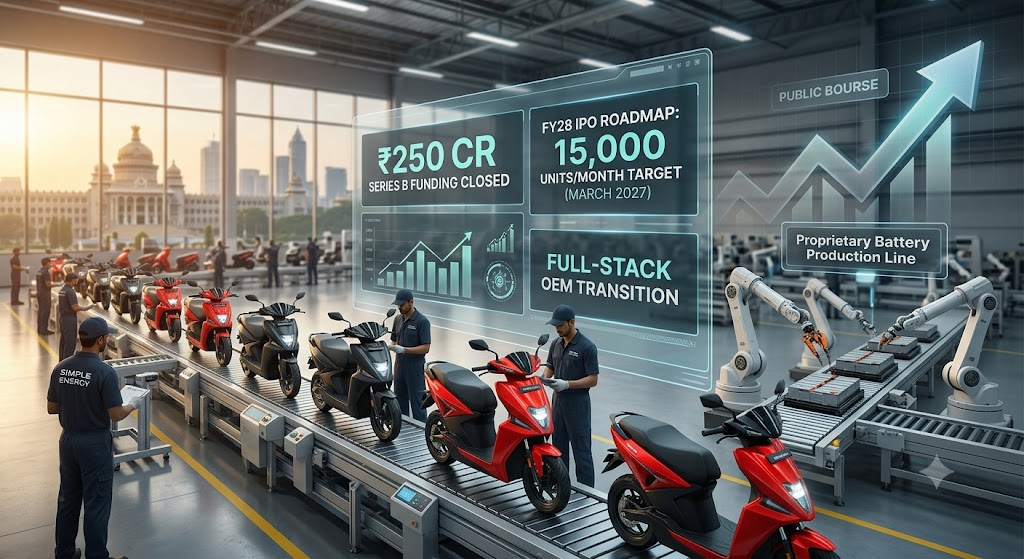
On paper, Simple Energy’s latest milestone hits every metric a growth-stage venture capitalist looks for: astronomical top-line expansion, high-profile backing, and a clearly mapped route to institutional liquidity. The Bengaluru-based electric two-wheeler manufacturer has capitalized on a massive 4.25x revenue explosion by closing a ₹250 crore Series B funding round. However, this capital injection arrives at a complex juncture for India’s electric vehicle ecosystem. While the numbers suggest hyper-growth, the macroeconomic backdrop is defined by public market skepticism. Simple Energy is executing a late-stage scaling strategy in an industry where public markets have already shown signs of fatigue with early-mover valuations. The architecture of this ₹250 crore round reveals a calculated approach to capital efficiency.
Instead of relying solely on dilutive equity, the startup secured a balanced combination of debt and equity financing. The equity portion was anchored by the high-profile family office of Dr. Arokiaswamy Velumani (founder of Thyrocare), alongside participation from Simple Energy’s founders, Suhas Rajkumar and Ankit Gupta. The remaining ₹123 crore was raised as debt from a consortium led by HDFC Bank and Capitar Ventures. The allocation of this capital is strictly industrial. The proceeds are earmarked to transition the company from a niche challenger into a high-volume, full-stack EV original equipment manufacturer (OEM). A major chunk will fund its proprietary battery production line, with the primary operational ramp-up projected to materialize over the second half of the fiscal year.
The true test of Simple Energy’s operational maturity lies in its ambitious production roadmap. The company currently operates at a baseline capacity of 3,000 units per month, with real-world sales hovering around 1,500 to 2,000 units. To build the necessary financial cushion for its upcoming public listing, the startup is targeting a monthly output of 10,000 units by March 2027, eventually scaling to 15,000 units. This operational surge requires expanding its retail footprint from 71 outlets across 38 cities into secondary and tertiary markets, including planned entries into Tier-II hubs like Ranchi, Bhubaneswar, and Cuttack. The company views this capital infusion as its official graduation from a localized startup into a national player. Suhas Rajkumar, Founder and CEO of Simple Energy, framed the transaction as a validation of their deep-tech integration. Suhas mentioned “The funding reflects strong investor confidence in Simple Energy. This will help us scale production, strengthen our Made-in-India manufacturing stack, and expand access to our long-range, performance-led scooters nationwide,” Rajkumar stated. “We are seeing clear market demand… This milestone marks Simple Energy’s transition from a homegrown startup to a full-stack EV OEM, reinforcing brand trust and readiness for a long-term path to public markets.” Simple Energy’s 4X revenue jump proves that its premium, long-range product proposition resonates with consumers. Yet, entering the public markets requires more than a strong growth rate; it requires predictability and robust aftermarket infrastructure.
When Simple Energy, Ather, and legacy spin-offs inevitably converge on the public bourses within a narrow timeline, public markets will shift from funding pure growth to demanding net profitability. For Simple Energy, the fresh ₹250 crore is an essential lifeline to build industrial scale—but its ultimate survival will depend on whether it can build an unshakeable retail and service network before the street sits in judgment of its business model. Simple Energy’s 4X revenue jump proves that its premium, long-range product proposition resonates with consumers. Yet, entering the public markets requires more than a strong growth rate; it requires predictability and robust aftermarket infrastructure. When Simple Energy, Ather, and legacy spin-offs inevitably converge on the public bourses within a narrow timeline, public markets will shift from funding pure growth to demanding net profitability. For Simple Energy, the fresh ₹250 crore is an essential lifeline to build industrial scale—but its ultimate survival will depend on whether it can build an unshakeable retail and service network before the street sits in judgment of its business model.