
ElasticRun Reworks Its Last Mile Delivery Playbook To Power India’s Growing Quick Commerce Boom
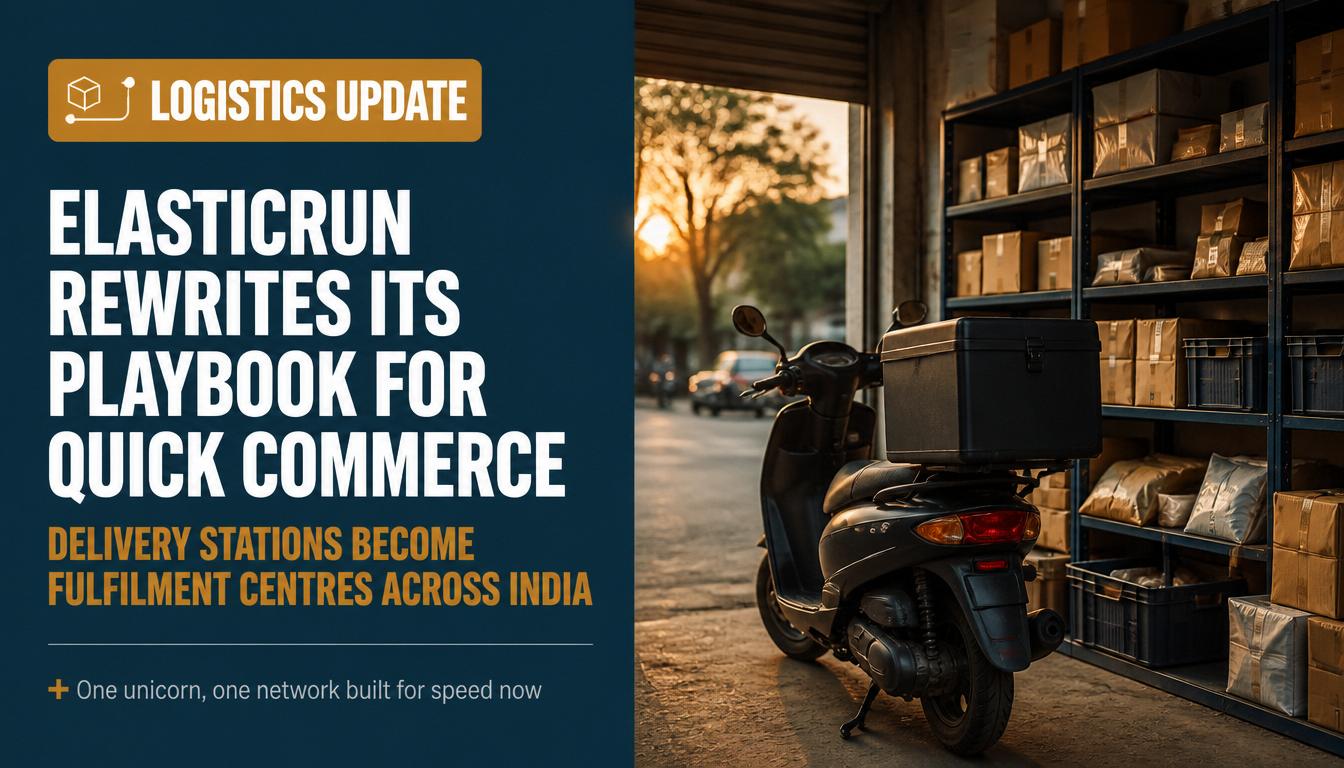
ElasticRun built its business connecting rural India to ecommerce and FMCG brands, but as quick commerce reshapes Indian retail, the unicorn is converting delivery stations into fulfilment centres, betting its hyperlocal network can survive scrutiny over service consistency.
Highlights:
- ElasticRun, a Pune based logistics unicorn, is reworking its playbook around quick commerce enablement
- The company is converting delivery stations into fulfilment centres that combine storage and delivery
- Its network spans over 1000 fulfilment centres and 50000 partners, reaching deep into rural India
- ElasticRun has raised 462 million dollars from investors including SoftBank, Prosus, and Avataar Ventures
- Industry sources say the company faces scrutiny over service consistency as delivery windows shrink
Every big shift in Indian retail eventually finds its way down to the last mile, the final, often messiest stretch between a warehouse and a customer’s doorstep.
Few companies understand that stretch better than ElasticRun, a Pune based logistics startup that spent its first several years quietly building distribution networks into places most ecommerce companies never bothered to reach. Now, as quick commerce reshapes how India shops, ElasticRun is reworking its playbook once again, converting a business built for patient, rural distribution into one built for speed.
ElasticRun was founded in 2016 by Sandeep Deshmukh, Saurabh Nigam, and Shitiz Bansal, three founders with backgrounds at companies like Amazon, Infosys, and DHL. Their goal was simple to state and hard to execute, get products from large brands into the hands of consumers in India’s smaller towns and villages without the crushing fixed costs of traditional logistics infrastructure.
Their answer was a technology platform that synchronised what Deshmukh describes as the three pillars of any logistics network, real estate, transportation, and vehicles, onto a single system operated largely through smartphones by a distributed network of local partners. That approach let the company scale to more than 1,000 fulfilment centres across the country while keeping costs low enough to make deep rural distribution commercially viable.
The company’s early growth followed a fairly clear arc. Between 2016 and 2019, ElasticRun scaled quickly serving ecommerce companies looking to reach beyond metro cities, becoming a key logistics partner for marketplaces like Amazon and Flipkart. Around 2019, it began engaging more deeply with fast moving consumer goods companies, a segment that accelerated sharply during the pandemic when traditional FMCG supply chains broke down.
That FMCG relationship became central to the business. ElasticRun now connects brands to more than 750,000 retail stores spread across over 1,600 cities.
The current phase of the company’s evolution is being driven by an entirely different force, the rapid rise of quick commerce. As supply chains shift away from large, centralised warehouses toward last mile centric fulfilment capable of delivering within minutes rather than days, ElasticRun’s existing network has suddenly become far more relevant than it was even two or three years ago.
The company is now converting what were previously simple delivery stations into full fulfilment centres, capable of both storing inventory and dispatching it for delivery from the same node.
Deshmukh frames it simply. Anyone launching quick commerce can now build directly on ElasticRun’s existing network, parking inventory within its system rather than constructing separate infrastructure from scratch.
This is a meaningful pivot for a company whose original thesis was built almost entirely around patient, cost efficient rural distribution rather than speed.
The scale ElasticRun has reached explains why investors have kept backing it through these pivots. The startup has raised 462 million dollars from investors including SoftBank, Prosus, and Avataar Ventures, reaching unicorn status along the way. Its customer roster includes Amazon, Flipkart, Myntra, Ikea, Supertails, Croma, and Mokobara.
Its partner network, now more than 50,000 strong, operates almost entirely through smartphone based tools, turning individuals across rural and semi urban India into small scale entrepreneurs earning regular income. One frequently cited example involves a visually impaired individual who approached ElasticRun to join its network, and who now manages one of its strongest performing operations, built on the strength of his local community connections.
Not every part of this transition has gone smoothly. According to multiple industry sources, ElasticRun’s execution track record in quick commerce has come under scrutiny, with reports of service consistency challenges affecting client retention in some cases. Quick commerce delivery windows can run as tight as two hours, a timeline where even minor inefficiencies produce outsized damage to brand experience.
ElasticRun disputes this characterisation directly. Deshmukh says the company has not lost a single enterprise client in the past twelve to eighteen months, and that its client base has actually grown during this period, driven largely by new D2C brands.
It is worth reading this transition with a balanced eye rather than treating it as either a success story or a cautionary tale. ElasticRun’s structural advantage, deep rural reach at costs traditional players have struggled to match, remains genuinely differentiated.
But the demands of quick commerce, sub two hour windows, exacting service expectations, thin margin brands with no tolerance for inconsistency, represent a genuinely different discipline than the one ElasticRun built its reputation on. A network built for patient, cost efficient reach is not automatically equipped for split second reliability.
There is also a fair question about sustainability, given how crowded India’s quick commerce logistics space has become, with well funded players like Zepto, Blinkit, and Swiggy Instamart building their own sophisticated infrastructure. ElasticRun’s bet is that its already built network gives it a structural cost advantage over rivals starting from scratch.
Whether the company manages that transition smoothly, or finds itself caught between two logistics disciplines it has not yet reconciled, will determine whether this becomes its next major growth chapter or a far harder struggle.