
What Microsoft Frontier Company’s $2.5 Billion Launch Really Says About Enterprise AI Adoption
Microsoft just committed $2.5 billion and 6,000 engineers to physically embed inside client companies and make AI actually work, and that scale of hand holding reveals an uncomfortable truth the industry rarely says out loud, self-serve enterprise AI has not been working nearly as well as vendors have claimed.
Highlights:
- Microsoft has launched Microsoft Frontier Company with a $2.5 billion investment and roughly 6,000 embedded engineers and consultants.
- The unit is led by Rodrigo Kede Lima, previously president of Microsoft Asia, and reports to Commercial Business CEO Judson Althoff.
- Early partners include the London Stock Exchange Group, Unilever, Land O’Lakes and Accenture.
- The launch follows AWS committing $1 billion to a similar forward deployed engineering unit just two days earlier.
- Judson Althoff insisted the initiative goes beyond the industry standard forward deployed engineer model, calling it the largest, most capable, outcome driven engineering organisation in the industry.
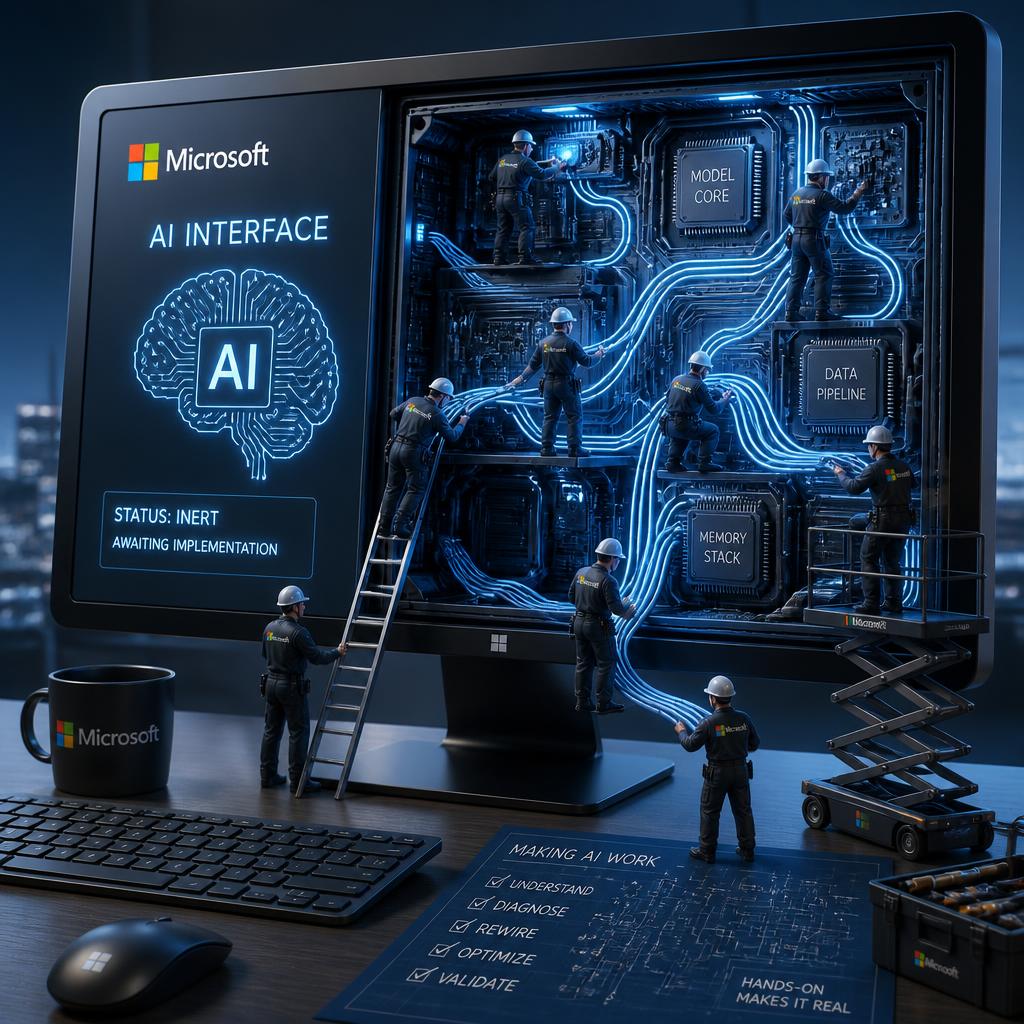
Every major AI vendor now sends its own engineers to physically sit inside customer companies and build AI systems for them, and this week Microsoft made the largest single bet on that model yet. Microsoft Frontier Company, announced on July 2, is backed by a $2.5 billion investment and roughly 6,000 industry specialists and engineers who will be embedded directly within client organisations to design, deploy and continuously refine AI applications. On the surface this reads as confident, aggressive expansion from the world’s most valuable enterprise software company. Read the announcement more carefully, though, and it starts to look like something closer to an admission, that the AI products vendors like Microsoft have already sold to thousands of enterprises are not, on their own, translating into the operational results those customers were promised.
The specifics of the launch are worth laying out plainly. Microsoft is investing $2.5 billion to build out this new operating business, which will embed approximately 6,000 engineers, technical consultants, support specialists and industry experts directly inside customer organisations, working alongside client teams to co-design AI applications rather than simply licensing software and walking away. Rodrigo Kede Lima, a longtime Microsoft executive who previously led sales operations across the Americas and Asia, has been named president of the new unit. Early partnerships already announced include the London Stock Exchange Group, Unilever, Land O’Lakes and Accenture, giving a sense of the scale and seniority of clients Microsoft expects this unit to serve. Judson Althoff, Microsoft’s Commercial Business CEO, was notably resistant to having this initiative lumped in with the now standard industry term for this approach, forward deployed engineering, writing that the new venture goes beyond what has been labelled Forward Deployed Engineering and will be the largest, most capable, outcome driven engineering organisation in the industry.
That resistance to the FDE label is itself revealing, because the model Microsoft is describing is, functionally, exactly that model, just executed at a scale no other vendor has yet committed to. The FDE approach, pioneered roughly two decades ago by Palantir and now being adopted industry wide, involves sending a vendor’s own technical staff to sit inside a customer’s operations, understand their specific workflows and data constraints, and hand build AI systems that actually function in that particular environment rather than relying on the customer’s own team to figure out implementation from documentation and generic support tickets. Microsoft’s launch comes just two days after Amazon Web Services committed $1 billion to its own version of this exact model, explicitly embracing the FDE terminology Microsoft is trying to avoid. OpenAI and Anthropic have both separately launched comparable joint ventures of their own, though notably involving outside capital from private equity firms rather than being funded entirely from the parent company’s own balance sheet, as Microsoft’s initiative is.
Step back from the individual announcement and look at the pattern across the entire industry, and a fairly stark picture emerges. Every major AI lab and cloud provider, OpenAI, Anthropic, Amazon, Microsoft, has independently arrived at the same conclusion within a matter of weeks of each other, that selling AI models and platforms alone is not sufficient to get enterprise customers to genuinely operational deployment. If self-serve AI tools were working as advertised, this entire category of billion dollar consulting style investment simply would not need to exist. Companies do not typically commit multi billion dollar sums and thousands of embedded staff to fix a problem that is already solved. The scale and near simultaneous timing of these announcements, Microsoft’s $2.5 billion following AWS’s $1 billion by mere days, suggests this is not a coincidental strategic overlap but rather a shared, urgent response to a genuine and widespread adoption gap that vendors have been observing across their enterprise customer bases for some time.
The underlying reason for that gap is not particularly mysterious once you look past the marketing language. Enterprise AI deployment is genuinely hard in ways that consumer facing AI products are not. It requires integrating with legacy systems that were never designed with AI in mind, protecting proprietary data in ways that generic cloud AI tools do not automatically handle, and building workflows specific enough to a company’s actual operations that generic prompts and pre-built templates simply cannot cover. Digital Watch Observatory’s coverage of the launch noted that Microsoft’s own framing of the initiative points directly at this, describing it as a response to enterprises struggling to embed AI tools into workflows, protect proprietary data and demonstrate measurable return on investment despite having already acquired the underlying AI tools themselves. That is a remarkably candid admission buried inside an otherwise triumphant product launch, enterprises already have the AI, they simply cannot make it work without an enormous amount of hands on, custom engineering effort that the tools themselves were supposed to minimise.
There is also a business model implication here that deserves more scrutiny than it is currently getting. Microsoft, at its core, has always been a software licensing company, a business built around the extremely favourable economics of building something once and selling it to millions of customers with minimal marginal cost per additional user. Forward deployed engineering inverts that economics almost entirely, it requires dedicated human engineers embedded at individual client sites, a cost structure that scales roughly linearly with the number of large enterprise clients served rather than benefiting from the near infinite operating leverage that made software companies so much more profitable than traditional consulting firms in the first place. By building Microsoft Frontier Company as a $2.5 billion, 6,000 person operation, Microsoft is effectively building a consulting business inside a software company, accepting materially worse unit economics in exchange for actually being able to prove that its AI products deliver the outcomes it has been selling enterprises on for the past several years.
None of this means the initiative is a bad idea, in fact it may be a necessary and overdue one. If enterprise AI adoption has genuinely stalled at the implementation stage, as the pattern of near simultaneous billion dollar investments from every major vendor strongly suggests, then embedding real engineering talent directly with customers is likely the only way to close that gap in the near term, generic self-serve tools clearly have not been sufficient on their own. Microsoft’s emphasis on model choice, explicitly telling customers they can use models from OpenAI, Anthropic, Microsoft AI, open source communities and specialised industry developers rather than being locked into a single provider, also suggests a degree of self-awareness that customers are wary of vendor lock-in at a moment when trust in any single AI provider’s long term reliability is still being established. But the framing of this launch as confident forward momentum obscures a more interesting and more honest story sitting underneath it, that two years into the generative AI enterprise sales cycle, the industry’s biggest players are only now admitting, through billions of dollars of committed capital rather than through words, that selling the technology was always going to be the easy part, and making it actually work inside real, messy, legacy laden enterprise environments is the problem nobody had actually solved yet.