
Hari Menon Steps Down as BigBasket CEO: Amazon Veteran Amit Nanda to Lead India’s Quick Commerce Pioneer
The man who put grocery shopping online for 25 million Indians steps back. The company he built now faces widening losses, fierce quick-commerce rivals and the weight of a market it helped create but struggled to dominate.
In October 2011, when Hari Menon and his co-founders launched BigBasket in Bengaluru, the idea of ordering your vegetables online and having them delivered to your door was genuinely radical. India’s grocery retail was, and largely still is, built around the neighbourhood kirana shop, the weekly market, the daily trip to the vegetable vendor. Putting that on a website and convincing people to trust it required not just technology but a kind of patient evangelism that only a certain kind of founder has the constitution to sustain across years of scepticism.
Menon had that constitution. For fifteen years he ran BigBasket through the chaos of early-stage startup uncertainty, the complexity of cold-chain logistics, the disruption of Tata Digital’s acquisition in 2021, and the existential challenge of the quick-commerce revolution that rewrote consumer expectations about what “fast delivery” actually means. On June 16, 2026, he stepped down as CEO. He will remain on the board. He will mentor the new leadership. But the day-to-day operations of the company he built are now someone else’s responsibility.
That someone else is Amit Nanda, who spent more than eleven years at Amazon India, most recently as Director of Selling Partner Services. Nanda brings with him a particular kind of operational fluency, the ability to manage scale, to think about marketplace dynamics, and to work within the structures of a large parent company, in this case the Tata Group, while maintaining the agility that a competitive market demands. Sajith Sivanandan, CEO of Tata Digital and chairperson of BigBasket, framed the appointment in terms of exactly those qualities.
“His experience in leading large-scale businesses and driving product and technology strategy across critical marketplace capabilities, combined with his deep understanding of digital commerce and consumer behaviour, makes him an excellent choice to lead BigBasket.”
Sajith Sivanandan, CEO, Tata Digital and Chairperson, BigBasket
Nanda, for his part, was direct about what attracted him to the role. “I am incredibly excited to join BigBasket and build upon the phenomenal trust it has established with millions of consumers across India,” he said. “Combining BigBasket’s customer-first values with the trusted legacy of the Tata Group creates a strong foundation for the future.”

The numbers that sit behind this leadership transition tell a complicated story. BigBasket’s B2C arm, Innovative Retail Concepts, reported turnover of ₹7,673 crore in FY25, a decline of 3% from the previous year. Losses widened sharply to ₹1,851 crore, up from ₹1,267 crore in FY24. The B2B business, Supermarket Grocery Supplies, posted revenue of ₹2,227 crore, also down nearly 7% year-on-year. For a company that once led the conversation about the future of grocery retail in India, these are numbers that demand explanation and, more importantly, a credible plan to reverse.
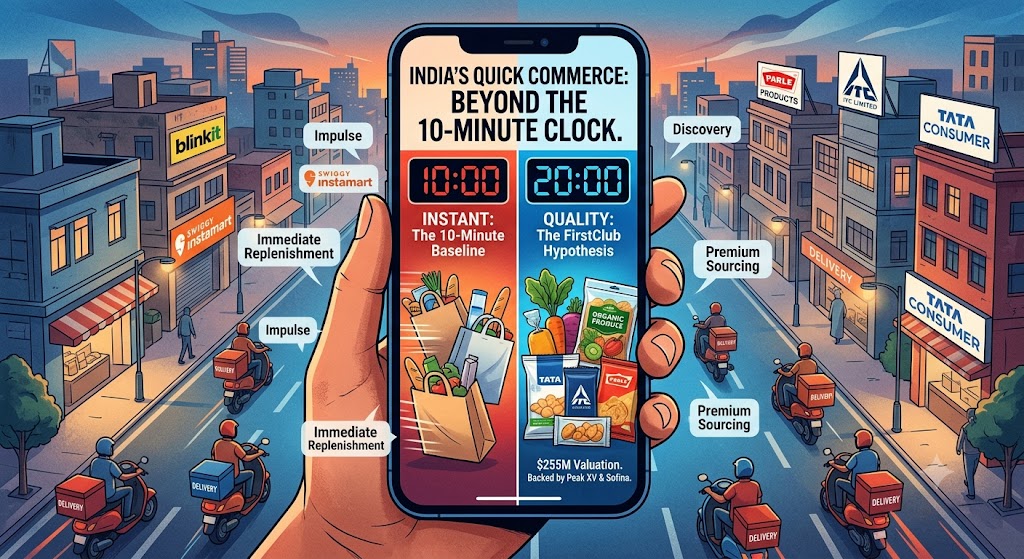
The explanation is not hard to find. BigBasket was built on a scheduled delivery model. You ordered your groceries, chose a delivery slot, and they arrived in a few hours or the next day. That model works well. It builds planning habits. It suits larger basket sizes and considered purchases. But it was never going to win the battle for the customer who runs out of milk at 9pm or needs onions for a recipe they are already cooking. Quick commerce, with its promise of delivery in 10 to 15 minutes, captured that customer. Blinkit, Zepto and Swiggy Instamart moved fast and built the dark store networks to back up their promises. BigBasket was, by Menon’s own acknowledgement, slower to embrace the quick-commerce model than its rivals.
The company has made up significant ground. It now operates more than 900 dark stores across 60 cities. It has invested in the last-mile infrastructure that 10-minute delivery requires. But catching up to rivals who moved earlier means fighting a market share battle while also carrying the cost structure of an earlier, different business model. That is the challenge Nanda inherits.
The broader management reset that has accompanied this CEO transition is also worth noting. Just two weeks before the Nanda announcement, BigBasket appointed Seshu Kumar Tirumala as Chief Operating Officer. In April, Arpit Jaiswal joined as Chief Growth Officer. The pattern suggests a deliberate and systematic refresh of the leadership bench rather than a single isolated change at the top. Tata Digital appears to be preparing BigBasket for a more aggressive phase of competition, and they are choosing to do it with executives who have experience in large-scale operational complexity rather than with the founding generation that built the company from zero.
Hari Menon deserves the credit that comes with having built one of India’s most recognisable consumer brands from nothing and sustained it through fifteen years of a market that constantly changed around him. What comes next for BigBasket under Nanda will be determined not by the legacy but by whether the operational reset, the dark store expansion, the leadership strengthening, and the Tata Group’s patient capital can together produce a business that is both growing and moving toward profitability in a quick-commerce market that has no shortage of well-funded, equally determined competitors.