

BigBasket Losses Widen 66 Percent To Rs 3073 Crore In FY26 As Quick Commerce Costs Mount
BigBasket’s losses jumped 66 percent to over three thousand crore rupees in FY26, even as revenue crept up just under 8 percent, a widening gap that shows exactly how expensive it has become for Tata’s grocery bet to keep chasing quick commerce rivals.
Highlights:
- BigBasket’s FY26 loss widened 66 percent to Rs 3073 crore, up from Rs 1850 crore in FY25
- Revenue for the year rose just 7.7 percent to Rs 8223 crore, a marginal gain by industry standards
- Parent company Tata Digital’s overall loss grew to Rs 4974 crore, with BigBasket driving roughly 64 percent of it
- BigBasket’s B2B arm Supermarket Grocery Supplies grew revenue 3.2 percent while holding losses steady at Rs 102 crore
- Tata Digital’s combined gross merchandise value has scaled to Rs 46515 crore within four years of launch
There is a particular kind of number that tells you more by how it moves than by what it says, and BigBasket’s latest set of financials is exactly that kind of number. Revenue barely stirred. The losses did not sit still at all.
According to Tata Sons’ annual report, BigBasket’s loss for the financial year ended March 2026 widened by 66 percent, landing at Rs 3,073 crore, up from Rs 1,850 crore the year before. Revenue, meanwhile, inched forward by just 7.7 percent, rising to Rs 8,223 crore from Rs 7,634 crore in FY25. Read those two figures side by side, and the story writes itself, growth is arriving in inches while the cost of chasing it is arriving in leaps.
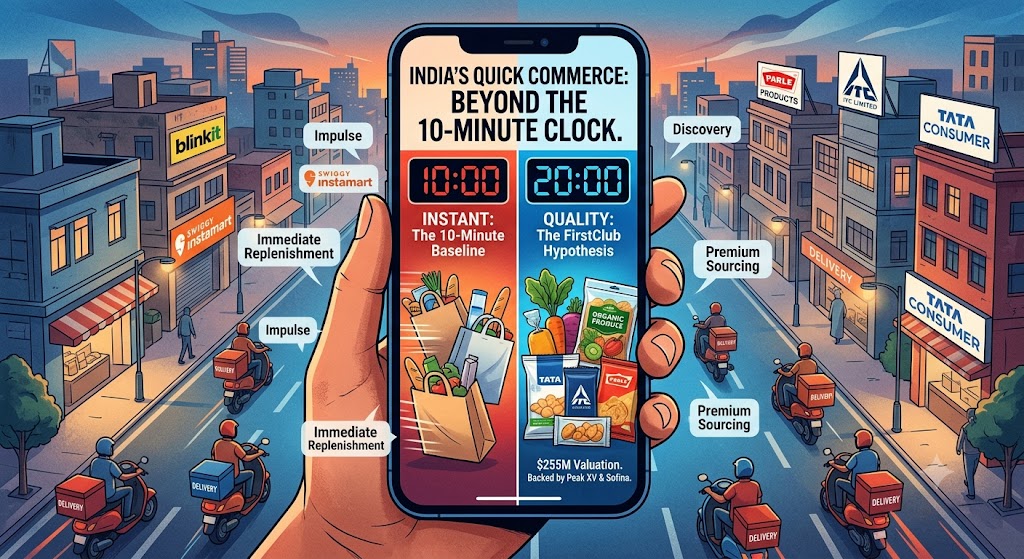
BigBasket has spent the past few years unwinding the very identity that made it India’s first large scale online grocer. Founded in 2011 as a considered, planned, next day delivery service, the company has been steadily rebuilding itself around BBNow, its quick commerce arm, chasing the ten minute delivery standard that Blinkit, Zepto, and Swiggy Instamart have made the price of entry rather than a differentiator. That pivot is not free, and this year’s numbers are the clearest evidence yet of exactly what it costs.
The company’s B2B arm, Supermarket Grocery Supplies, tells a marginally steadier story within the same filing. Revenue there rose 3.2 percent to Rs 2,298 crore, up from Rs 2,227 crore in FY25, while losses held essentially flat at Rs 102 crore across both years. It is a small, stable corner inside an otherwise turbulent balance sheet, proof that not every part of BigBasket’s business is bleeding at the same rate, even as the consumer facing side absorbs the brunt of the quick commerce war.
Zoom out to the parent level, and the picture grows heavier still. Tata Digital, the umbrella entity housing BigBasket alongside Croma, Tata 1mg, Tata Cliq, and the Tata Neu super app, reported a consolidated net loss of Rs 4,974 crore for FY26, up 7.9 percent from Rs 4,610 crore in FY25. BigBasket alone accounted for roughly 64 percent of that total loss, the single largest drag inside a portfolio built to eventually justify one of the country’s most expensive digital consolidation bets.
“The Indian ecommerce market shifted rapidly towards quick commerce, which BigBasket is adapting to,” said N Chandrasekaran, chairman of Tata Sons, in his shareholder letter. “In FY26, Tata Digital reported a loss of Rs 4,974 crore. But Tata Digital’s ambitions are great and are beginning to show progress.”
Chandrasekaran’s letter leaned on a different set of numbers to make its optimism land, pointing to Tata Digital’s combined gross merchandise value, which he said has scaled to Rs 46,515 crore within just four years of launch. He listed the group’s other assets in the same breath, Croma’s own Rs 25,539 crore GMV, Tata 1mg’s position as India’s top ranked epharmacy and ediagnostics platform, and the Tata Neu credit card’s standing as one of the country’s largest co branded cards, a portfolio wide framing that positions BigBasket’s losses as the price of building something considerably larger than a single grocery app.
That framing extends into an explicit strategic pivot elsewhere in the portfolio. Tata Sons confirmed it is refocusing Tata Neu away from its original ambition as a broad, everything super app and toward financial services and customer loyalty specifically, strengthening payments, lending, and insurance offerings while pushing to grow its monthly transacting users tenfold through the NeuPass loyalty layer. It is a quiet admission that the super app model, at least in its original all in one form, has not delivered the engagement Tata hoped for, and that the group is now betting on financial services stickiness instead.
BigBasket’s own executives have been telling a more upbeat growth story in the months leading up to this filing. Chief buying and merchandising officer Seshu Kumar Tirumala had earlier told reporters the company was targeting 50 to 60 percent revenue growth for FY26, built on month on month sales growth of around 5 percent and a customer base expanding 6 to 7 percent. The final numbers landed nowhere near that ambition. A 7.7 percent annual revenue increase is a fraction of the growth rate the company itself was projecting only months earlier, a gap worth sitting with rather than glossing over.
“We are currently growing at about 5 per cent month on month, which would be 50 to 60 per cent year on year,” Tirumala had said. “It’s actually our top priority to ensure overall growth, and we are on that path.”
It is worth being precise about what actually happened between that projection and this result. Sales momentum measured in short monthly bursts does not always compound the way a simple multiplication suggests it should, particularly in a category as promotionally driven and discount sensitive as quick commerce, where a strong month can be followed by a flat one the instant a rival platform runs a more aggressive campaign. BigBasket’s actual FY26 outcome suggests exactly that kind of unevenness, real growth in places, but nowhere close to the sustained, compounding trajectory the company’s own leadership had described with such confidence.
There is also a fair question worth asking about what this scale of loss actually buys. BigBasket has been steadily expanding its dark store network, aiming for roughly 900 large format stores by March 2026, each one stocked with around 25,000 assortments and each one carrying real fixed costs regardless of order volume on any given day. Advertising and marketing spend had already surged 51 percent the previous year as the company leaned into promotion to defend market share, and a jump of this size in losses suggests that spending discipline has not meaningfully tightened even as growth has slowed rather than accelerated.
None of this means BigBasket’s underlying strategic logic is wrong. India’s grocery and quick commerce market remains one of the largest, fastest evolving retail categories in the country, and being present, even at a heavy loss, keeps BigBasket relevant in a market where standing still is its own kind of failure. Tata Digital’s willingness to keep absorbing losses of this scale, rather than pulling back, suggests the group still views BigBasket as a strategically necessary asset rather than a business it expects to abandon. Whether that patience eventually converts into the kind of durable, profitable scale Chandrasekaran’s letter gestures toward, or whether BigBasket simply keeps growing its losses faster than its revenue year after year, will depend far less on this single annual filing and considerably more on whether the company can finally make its next year’s growth numbers match the ambition its own executives keep describing out loud.