
PM Modi Launches India’s First Hydrogen Powered Train On Jind Sonipat Route What It Really Changes
Prime Minister Narendra Modi launched India’s first hydrogen powered train on the Jind to Sonipat route, a genuine engineering milestone, but one that arrives with a cost tag and hydrogen supply questions that will decide whether this stays a symbol or becomes a real network.
Highlights:
- PM Modi flagged off India’s first hydrogen powered train on the Jind to Sonipat route
- The 10 coach train can carry nearly 2600 passengers, the largest hydrogen train capacity in the world
- The pilot project cost is estimated between Rs 112 crore and Rs 136 crore
- Indian Railways plans a wider rollout of 35 hydrogen trains under a Rs 2800 crore programme
- Experts say green hydrogen remains costlier than electrification, raising questions about wider rollout economics
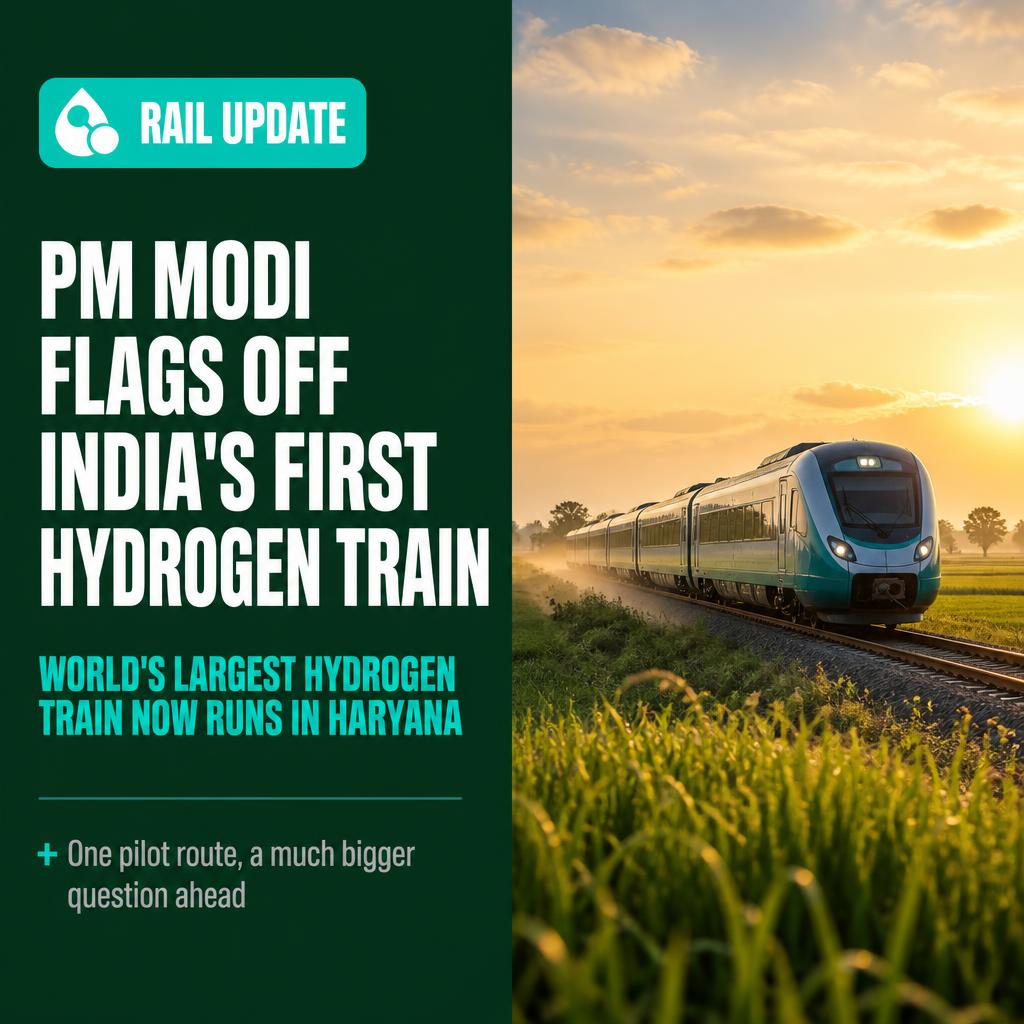
Every new form of railway power in India has arrived carrying a certain amount of ceremony, and this one was no exception. On July 17, Prime Minister Narendra Modi flagged off India’s first hydrogen powered passenger train at Jind railway station in Haryana, calling it a new global benchmark for clean rail technology.
The train will run on the 89 kilometre stretch between Jind and Sonipat, chosen as the pilot corridor for a technology India has been quietly building toward for several years.
Designed, engineered, and integrated domestically, the 10 coach train is built to carry nearly 2,600 passengers, which officials describe as the largest passenger capacity of any hydrogen train currently operating anywhere in the world. That distinction matters because most existing hydrogen trains internationally, including those running in Germany, run with far smaller five coach formations.
With this launch, India joins a genuinely small club of nations. Germany, Japan, China, and the United States have all operated hydrogen powered trains in some form, and India’s entry brings the total to five countries testing or running this specific technology.
The engineering behind the train is fairly intricate. Rather than building an entirely new train from scratch, Indian Railways retrofitted an existing Diesel Electric Multiple Unit rake with a hydrogen fuel cell propulsion system.
Each of the train’s two driving power cars carries four integrated power packs, and each power pack produces 300 kilowatts of energy, split between 115 kilowatts from the hydrogen fuel cell itself and 185 kilowatts from a lithium ferro phosphate battery working alongside it. Together, the four power packs in one driving car generate 1,200 kilowatts, giving the train a combined propulsion output that officials have also described in press materials as roughly 3,200 horsepower.
Unlike conventional electric trains, which draw power continuously from overhead wires, this train generates its own electricity onboard through a chemical reaction between stored hydrogen and oxygen drawn from the surrounding air, producing only water and heat as by products.
To support this, an indigenous hydrogen production, storage, and refuelling facility has been built at Jind, with a storage capacity of 3,000 kilograms, using electrolysis to generate the hydrogen locally, complete with safety approvals from the Petroleum and Explosives Safety Organisation.
Speaking at the launch, PM Modi framed the moment within a longer arc of railway history, noting that nineteenth century railways were defined by the steam engine, the twentieth century belonged to diesel and electric trains, and the twenty first century train now runs on hydrogen.
He described the launch as the fulfilment of a long held dream, and called it a landmark moment for both self reliance and sustainable development.
The financial picture behind this pilot is where the more complicated part of the story begins. Independent estimates put the total pilot project cost somewhere between Rs 112 crore and Rs 136 crore, roughly 12 to 16 million dollars, a figure that covers both the train conversion itself and the dedicated hydrogen infrastructure built to support it.
Of that, Hyderabad based Medha Servo Drives secured a roughly Rs 70 crore contract specifically to retrofit the DEMU rake with its hydrogen fuel cell system, while a further Rs 111.83 crore was separately sanctioned to build out the ground infrastructure needed to produce, store, and supply hydrogen at Jind.
This single pilot is meant to inform something much larger. Indian Railways has proposed a Rs 2,800 crore programme called Hydrogen for Heritage, aimed at deploying 35 hydrogen trains across the country, largely on heritage and non electrified routes that are harder or less economical to fully electrify through conventional means.
Railway Minister Ashwini Vaishnaw has previously told Parliament that the hydrogen train set’s manufacturing has been completed according to specifications framed by the Research, Design and Standards Organisation, describing the effort as a state of the art project meant to demonstrate the technology on a pilot basis before any wider commitment.
It is worth being fairly direct about what this project is, and just as importantly, what it is not, at this stage. It is a genuine engineering achievement, an indigenously designed and built hydrogen train that reportedly outperforms comparable trains running in other countries on both capacity and power output. It is not yet evidence that hydrogen powered rail is close to being commercially competitive with the electrification Indian Railways has already invested heavily in over the past decade.
Independent analysts examining the project have been fairly consistent in flagging the same core tension. Green hydrogen remains meaningfully costlier to produce than the electricity Indian Railways already draws from its extensive overhead electrification network, and the cost per kilometre of running a hydrogen train, once ground infrastructure and fuel production are factored in, currently sits well above what electrified traction costs on comparable routes.
That is precisely why this technology is being positioned specifically for heritage and non electrified routes rather than as a broad replacement for electrification itself. Indian Railways has already electrified the overwhelming majority of its network in recent years, meaning hydrogen’s realistic near term role is filling in gaps, not replacing what already works well and costs less to run.
There is also a practical infrastructure question sitting underneath the economics. A single hydrogen train is only as useful as the refuelling network available to support it, and right now, that network consists of exactly one facility, built specifically for this pilot at Jind.
Scaling to 35 trains under the proposed Hydrogen for Heritage programme would require replicating this kind of dedicated production and storage infrastructure at multiple locations across the country, a considerably larger undertaking than building the trains themselves, and one that will depend heavily on how quickly green hydrogen production costs fall as the broader National Green Hydrogen Mission matures.
There is a genuine strategic logic sitting behind this project too, separate from the pure cost question. India remains a large importer of crude oil, and any reduction in diesel consumption across its rail network, even confined to a handful of pilot corridors initially, contributes in a small but real way to energy security, an argument that has gained additional weight given recent disruptions to global shipping lanes that have exposed how vulnerable fossil fuel supply chains can be.
Seen this way, the Jind to Sonipat corridor carries symbolic weight that outpaces its immediate operational footprint. It demonstrates that Indian engineers can design and build hydrogen rolling stock domestically, a capability several larger economies have so far chosen to purchase from established manufacturers rather than develop on their own.
Whether that demonstrated capability turns into a genuinely useful, cost competitive part of India’s railway network, or remains a well engineered but economically marginal pilot confined to a handful of heritage routes, depends on three fairly specific and measurable factors over the next year, how quickly green hydrogen production costs actually fall, how durable the fuel cell system proves under real world Indian operating conditions including heat, dust, and heavy daily use, and whether refuelling infrastructure can realistically be built out beyond this single Jind facility at a pace and cost that makes the wider 35 train rollout financially sensible rather than merely technically impressive.