
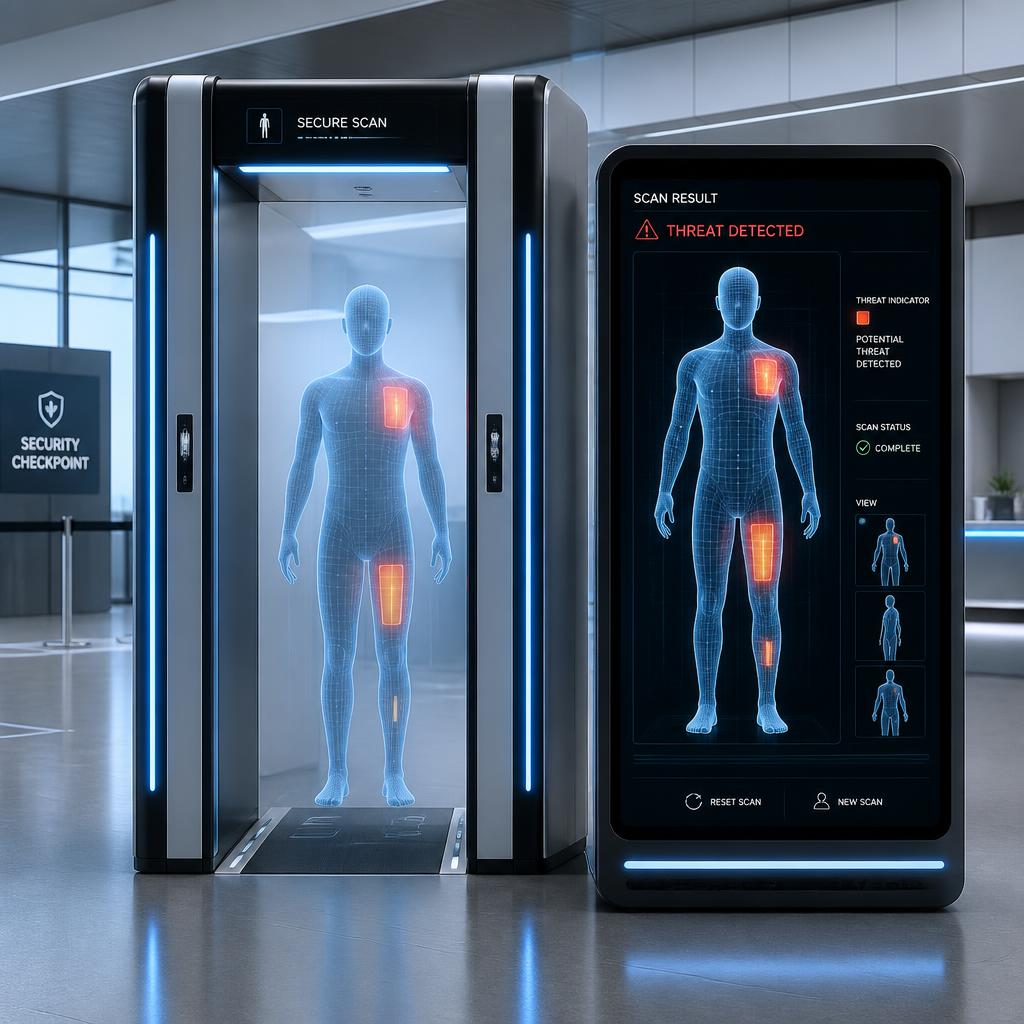
Vehant Technologies Launches MilliView India First Indigenous Millimetre Wave Body Scanner To Detect Metallic And Non Metallic Threats Advanced Security
Vehant Technologies has launched MilliView, India first indigenous millimetre wave body scanner developed with IIT Delhi, which utilizes artificial intelligence to detect both metallic and non metallic threats in under five seconds while completely protecting passenger privacy at security checkpoints
Ensuring public safety at high transit zones like airports and railway stations has always been a balancing act between absolute security and passenger convenience. For decades, security checkpoints have heavily relied on standard metal detectors, which often fail to spot modern, dangerous items made of non metallic components. Addressing this major security gap, Noida based security tech firm Vehant Technologies has officially unveiled a groundbreaking security solution. The company has introduced MilliView, which stands as India first completely domestic millimetre wave body scanner, marking a major milestone in the country push for self reliance in critical security infrastructure.
The newly launched device is the product of intensive deep tech engineering, designed to completely reimagine how security personnel screen individuals. Traditional methods often require physical pat downs or multiple slow checks when an alert is triggered, creating massive lines and passenger frustration. MilliView solves this problem by combining safe, non ionising millimetre wave imaging with advanced artificial intelligence threat recognition software. This intelligent system has been built to automatically identify hidden hazards without requiring physical contact, making the entire process smoother for everyday travelers while significantly upgrading defense levels at sensitive installations.
The development of this advanced screening machine was not an overnight achievement, but rather the result of a close, five year research partnership with the Indian Institute of Technology Delhi. Unlike foreign scanners that are pre programmed to look for international threat profiles, MilliView is uniquely calibrated to detect items specified under Indian regulatory guidelines. It effortlessly identifies a wide array of banned materials, including liquid or gel based explosives, detonators, firearms, and sharp objects. Furthermore, the system directly addresses long standing privacy concerns. Instead of generating or displaying anatomical images of a person body, the software instantly maps any suspected threat onto a generic, gender neutral digital avatar, protecting individual privacy while giving security officers precise, actionable information.
The operational metrics of the new scanner are designed to handle the intense pressures of modern transport hubs. The entire screening process, from the moment a passenger steps into the designated scanning position to the final computerized clearance decision, takes less than five seconds. This rapid processing speed is crucial for reducing crowd congestion at busy checkpoints. Vehant Technologies brings a wealth of experience to this rollout, as the firm was originally incubated at IIT Delhi back in 2005. Today, the indigenous technology company already has its security solutions successfully deployed across more than 115 airports, numerous transit centers, and over 80 smart cities throughout India.
The company leadership believes this launch will fundamentally change security dynamics. Kapil Bardeja, the co founder and chief executive officer of Vehant Technologies, stated that MilliView brings a new generation of intelligent, nonintrusive screening capability to modern security ecosystems where speed, accuracy, and passenger experience must work together harmoniously. He further explained that the biggest advantage of this millimetre wave technology is its ability to deliver high performance threat detection without creating unnecessary friction for passengers. Bardeja also noted that the company plans to obtain certification from the European Civil Aviation Conference, which will eventually allow them to export this Indian made technology to international markets across Europe, the Middle East, and Africa.
In conclusion, the introduction of MilliView represents a significant leap forward for domestic technology and national security infrastructure. By reducing reliance on expensive imported scanning systems, the country takes a firm step toward technological sovereignty in a critical sector. The combination of artificial intelligence with privacy preserving measures successfully solves the twin challenges of keeping citizens safe while respecting personal dignity. However, widespread adoption will require substantial initial capital investments from airport operators and government agencies, and the real world durability of these advanced software algorithms under continuous, high volume use remains to be fully proven over time. Nevertheless, if the system delivers on its promise of five second throughput, it will likely set a new benchmark for public security, effectively proving that advanced technology can make society safer without making life more complicated.