

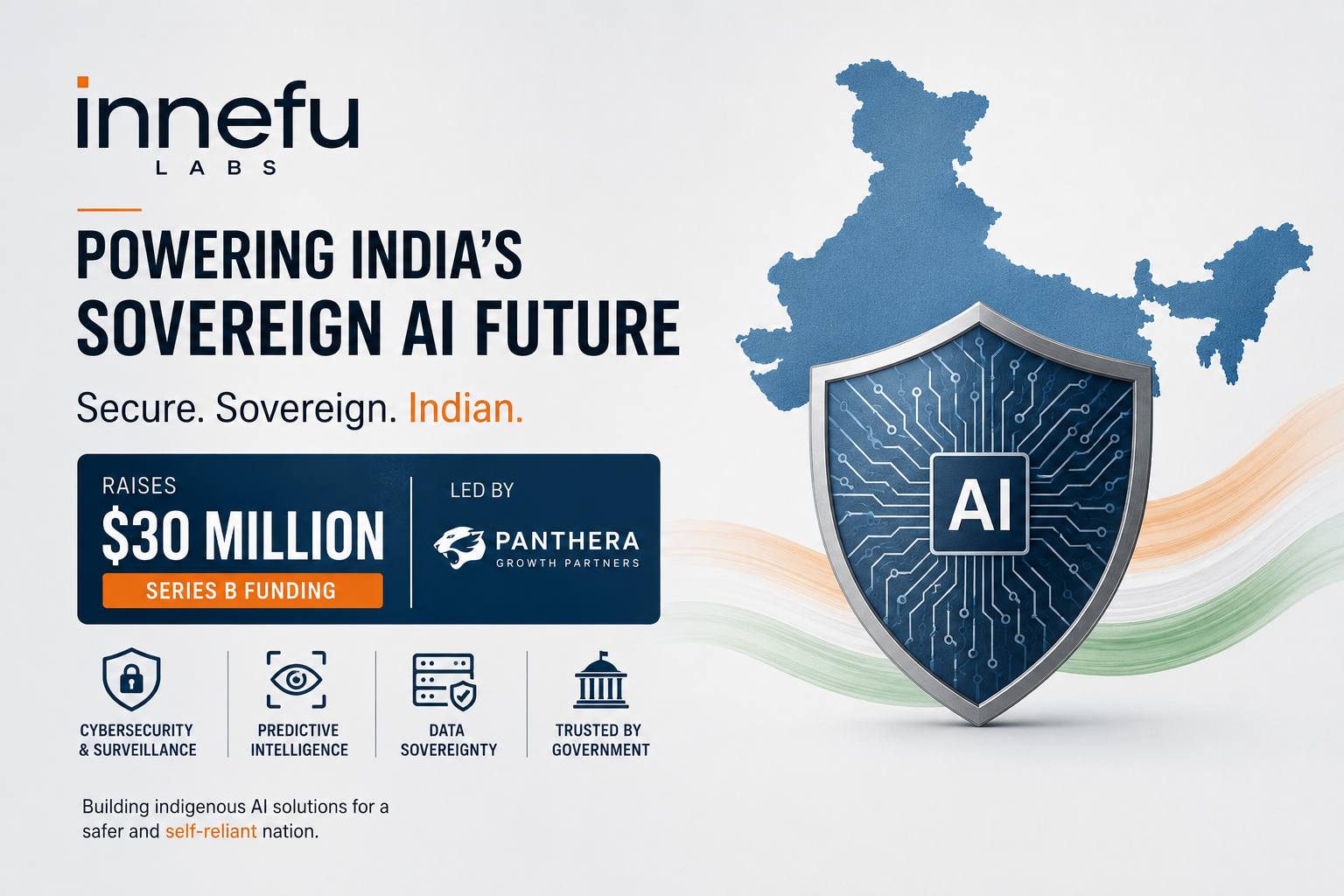
New Delhi’s Innefu Labs Raises $30M to Prove India Can Build Sovereign Defense AI
India’s defense ecosystem relies heavily on foreign surveillance software. New Delhi-based Innefu Labs just raised $30 million from Panthera Growth Partners to challenge Western and Israeli dominance, aiming to prove that local, sovereign AI can safeguard national security.
For decades, India’s national security apparatus has operated under a glaring contradiction: while championing strategic autonomy on the global stage, its defense and intelligence agencies remain deeply tethered to foreign technology. Much of the country’s advanced surveillance, facial recognition, and threat-analysis infrastructure is imported from Israel, the United States, or Europe. This reliance not only strains state coffers with recurring licensing fees but also exposes sensitive geopolitical data to foreign ecosystems.
Now, a 15-year-old New Delhi-based firm is betting that India is finally ready to sever those ties. Innefu Labs has secured $30 million in a Series B funding round, positioning itself at the vanguard of the country’s push for “Sovereign AI”—the doctrine that a nation must own, build, and control the code that protects its borders.
The concept of sovereign AI has transitioned from a nationalist talking point to a hard budget priority. In an era where algorithms dictate battlefield awareness and predictive policing, dependence on third-party nations introduces severe vulnerabilities. A software patch withheld or a back-door exploit could compromise critical operations during a geopolitical crisis.
Innefu Labs has spent a decade and a half building a proprietary tech stack tailored to these exact anxieties. By developing localized cybersecurity and data analytics frameworks, the company offers an alternative to foreign vendors. The freshly capitalized $30 million round, led by Singapore-headquartered Panthera Growth Partners, consists of a mix of primary and secondary capital. The influx is explicitly designed to institutionalize the company’s balance sheet ahead of an upcoming Initial Public Offering (IPO).
Unlike typical software-as-a-service (SaaS) startups that rely on speculative future growth, Innefu’s valuation is anchored by realized government trust. The company currently commands over $10 million in active contracts distributed across law enforcement, intelligence wings, and defense agencies within India and the Middle East.
Securing government contracts is notoriously difficult for early-stage companies due to rigid bureaucratic tenders and multi-year vetting cycles. Innefu’s ability to transition from pilot programs to recurring defense contracts indicates a mature product-market fit in a sector that is historically risk-averse.
The capital injection is less about survival and more about scaling up to meet structural shifts in how governments buy technology. Speaking on the strategic direction of the firm, Abhishek Sharma, Co-Founder and Chief Technology Officer (CTO) of Innefu Labs, has consistently emphasized that data sovereignty is non-negotiable for modern states.
According to leadership insights, the capital will be deployed to deepen their predictive intelligence capabilities and scale operations globally. The firm’s mandate is to prove that an Indian deep-tech company can match the sophistication of global defense giants while adhering to strict local compliance and data localization laws.
From a market perspective, Innefu Labs stands at a critical crossroads. Private equity rushing into defense tech is a relatively new phenomenon in India, historically deterred by the long cash-conversion cycles of government procurement.
Investors are betting that persistent border tensions and a domestic policy mandate (“Aatmanirbhar Bharat”) will insulate defense budgets from broader macroeconomic downturns. In this climate, “Sovereign AI” acts as a defensive moat for the business; governments are highly unlikely to rip out and replace core intelligence software once it is integrated.
Innefu Labs’ $30 million round is a landmark proof-of-concept for India’s deep-tech ecosystem. It demonstrates that local venture capital is mature enough to fund capital-intensive defense solutions. However, the company’s long-term viability hinges on its upcoming IPO performance. If public markets price Innefu as a volatile government vendor, it may cool private investment in the sector. But if Innefu successfully positions itself as a scalable sovereign tech giant, it could provide the blueprint for a self-reliant Indian defense-industrial complex.