
Compact AI Advisory System Developed With Microsoft And Oxford Doubles Sugarcane Yields For Farmers In Maharashtra
A lightweight, low cost artificial intelligence advisory system built with Microsoft and Oxford University is helping sugarcane farmers in Baramati nearly double their yields, offering a rare, working example of AI reaching India’s smallest and most vulnerable farms.
Highlights:
- The AI system was piloted by Krishi Vigyan Kendra Baramati with Microsoft and Oxford University
- The experiment ran across roughly 1,000 farmer fields starting March 2024
- Sugarcane farmers in Aland taluk have achieved nearly double yield using similar tools
- One documented Maharashtra platform recorded yields rising 57 percent on average
- Water usage has fallen by as much as 40 to 50 percent on participating farms
- The state’s MahaAgri AI policy now aims to scale similar tools statewide through 2029
For a technology so often discussed in the context of chatbots, coding assistants and billion dollar valuations, artificial intelligence has quietly found one of its most consequential Indian applications in a place that could not be further from a Silicon Valley boardroom—the sugarcane fields of western Maharashtra. In Baramati, a region long known as the backbone of the state’s sugarcane economy, a low-cost, sensor-driven AI advisory system has been helping farmers push yields to levels that traditional cultivation methods rarely achieve, and it is doing so using tools simple enough to be deployed on the fields of smallholders who have never used a laptop.
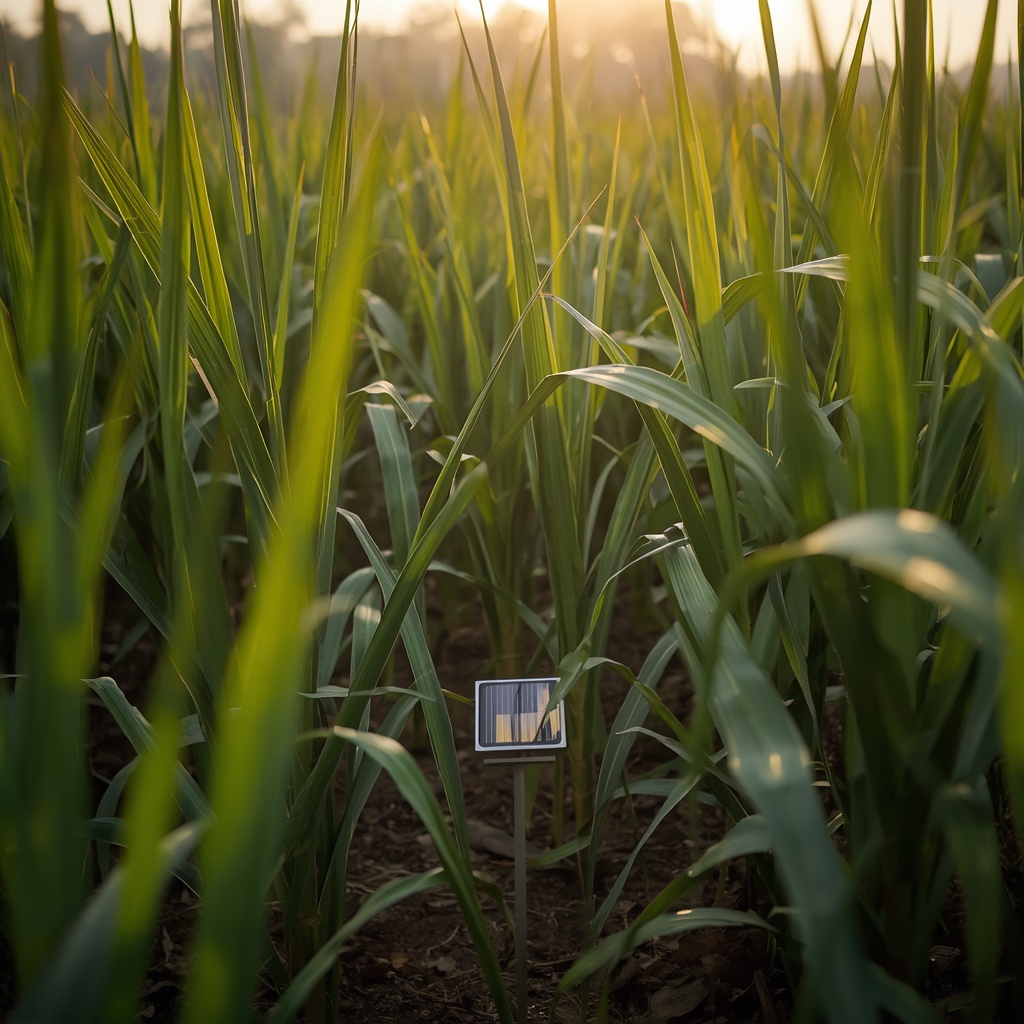
The initiative traces back to an experiment run by Krishi Vigyan Kendra Baramati, working through the Agricultural Development Trust, in partnership with Microsoft and Oxford University. Described by those involved as the first project of its kind attempted in the country, the experiment placed sensors directly into sugarcane fields to continuously monitor soil moisture, temperature and crop health, feeding that data into an AI system that then issues real-time guidance to farmers on exactly when and how much water, fertiliser and other inputs their crop actually needs. Starting from March 1, 2024, the programme was tested across roughly 1,000 farmer fields, and the results were positive enough that the model has since been cited as inspiration for similar rollouts in neighbouring regions of Karnataka.
The mechanics of how this actually helps a farmer are worth explaining plainly, because the value here lies less in the sophistication of the underlying AI model and more in how directly its output translates into decisions a farmer can act on immediately. Soil sensors placed in the field continuously track moisture and nutrient levels, and that data is combined with satellite-based monitoring and localised weather forecasting to generate specific, actionable alerts—telling a farmer, for instance, that irrigation should be delayed by two days, or that a particular section of the field is showing early signs of pest stress before it becomes visible to the naked eye. This is a meaningful departure from how most smallholder farmers have traditionally made these decisions, largely through inherited intuition and fixed calendar-based routines that do not account for the specific conditions of a given season or a given plot of land.
The scale of improvement documented across related deployments in the region has been genuinely striking. One AI-powered precision sugarcane platform now monitoring more than 3,000 farms across Maharashtra, Karnataka, Madhya Pradesh and Tamil Nadu—spanning over 15 districts in partnership with more than 25 sugar cooperatives and farmer producer organisations—has documented farmers achieving yields of between 221 and 358 tonnes per hectare, compared with a traditional range of just 98 to 148 tonnes, an improvement exceeding 57 percent on average. The same platform reports that AI-guided fertigation has reduced fertiliser use by between 20 and 25 percent while actually improving nutrient efficiency, and that early pest alerts generated through the system have cut crop losses by 10 to 15 percent. Separately, farmers in Aland taluk, just across the border in Karnataka, have reported achieving nearly double their previous yield after adopting AI-driven precision irrigation and IoT sensor tools modelled directly on what was first demonstrated in Baramati, with support from NSL Sugars and the local Krishi Vigyan Kendra.
“AI is not a magic wand and must be built on trusted data, good governance and accountability. When AI tools are deliberately designed around the real constraints smallholder farmers face—low connectivity, limited literacy, thin financial margins—they can produce measurable gains in yield, water efficiency and farmer income within a remarkably short window.”
Water savings, in a state where water scarcity remains one of the single biggest constraints on agricultural productivity, may ultimately be the more consequential number here than yield alone. Documented pilots in the Islampur Sugarcane Cooperative, using a related AI irrigation system developed by Jain Irrigation, recorded a 50 percent reduction in water usage alongside a 30 percent yield increase and an additional 15,000 rupees in annual revenue per participating farmer—results strong enough that 50 neighbouring villages subsequently adopted the same approach on their own. In Osmanabad, a separate cooperative using AI-guided drip irrigation cut water consumption by 40 percent while simultaneously increasing yields by 18 percent, demonstrating that these gains are not confined to a single pilot site but appear to be replicable across genuinely different local conditions and farmer populations.
None of this progress has come without acknowledging real structural barriers that limit how far these tools can currently reach. By some estimates, around 70 percent of smallholder farmers in the state lack access to smartphones or basic computer literacy, a gap that would render any purely app-based AI tool functionally useless for the majority of the very population it is meant to serve. Organisations such as Digital Green have responded by using video-based, spoken-language AI lessons rather than text-heavy interfaces to reach farmers in districts like Dhule, while low-cost platforms such as FarmLogs, priced at around 500 rupees a month, are attempting to bring AI-powered recommendations within reach of farms that could never justify the cost of more sophisticated sensor networks on their own.
Maharashtra’s state government has taken direct notice of these results and moved to formalise support around them. Speaking at the India AI Impact Summit held in New Delhi earlier this year, Chief Minister Devendra Fadnavis pointed specifically to the state’s MahaAgri AI policy and its multilingual mobile advisory platform, MahaVISTAAR AI, which he said has already reached around 25 lakh farmers with personalised guidance on weather, irrigation, fertiliser use, market prices and government schemes. He was careful to frame the technology’s role with appropriate caution rather than overpromising, noting that AI must be built on trusted data, good governance and accountability, a framing that acknowledges nearly half the country’s population still depends on agriculture for its livelihood. The state cabinet has since approved a dedicated policy framework, MahaAgri AI 2025-29, aimed at scaling generative AI, drone technology, computer vision and predictive analytics across the sector over the coming years, building on existing digital infrastructure including AgriStack and the Mahavedh weather monitoring network.
There is a version of this story that risks overselling a still-emerging technology as a definitive solution to structural problems in Indian agriculture that long predate any AI system—land fragmentation, credit access, climate volatility and market price uncertainty chief among them. It is worth resisting that temptation. What the Baramati experiment and its various offshoots actually demonstrate is narrower but still genuinely significant: that when AI tools are deliberately designed around the real constraints smallholder farmers face—low connectivity, limited literacy, thin financial margins for error—rather than assuming access to smartphones and steady internet, they can produce measurable, replicated gains in yield, water efficiency and farmer income within a remarkably short window. Whether Maharashtra can scale that early success across its full sugarcane belt, and whether other states successfully replicate it rather than merely announcing similar pilots without the underlying infrastructure to support them, will be the real test of whether this becomes a genuine turning point for Indian agriculture or simply a well-documented pilot that struggled to outgrow its original 1,000-farm footprint.