
IIT Bombay Alumni Build WeatherEx AI Weather Platform To Forecast Mumbai’s Unpredictable Monsoon Rainfall Patterns
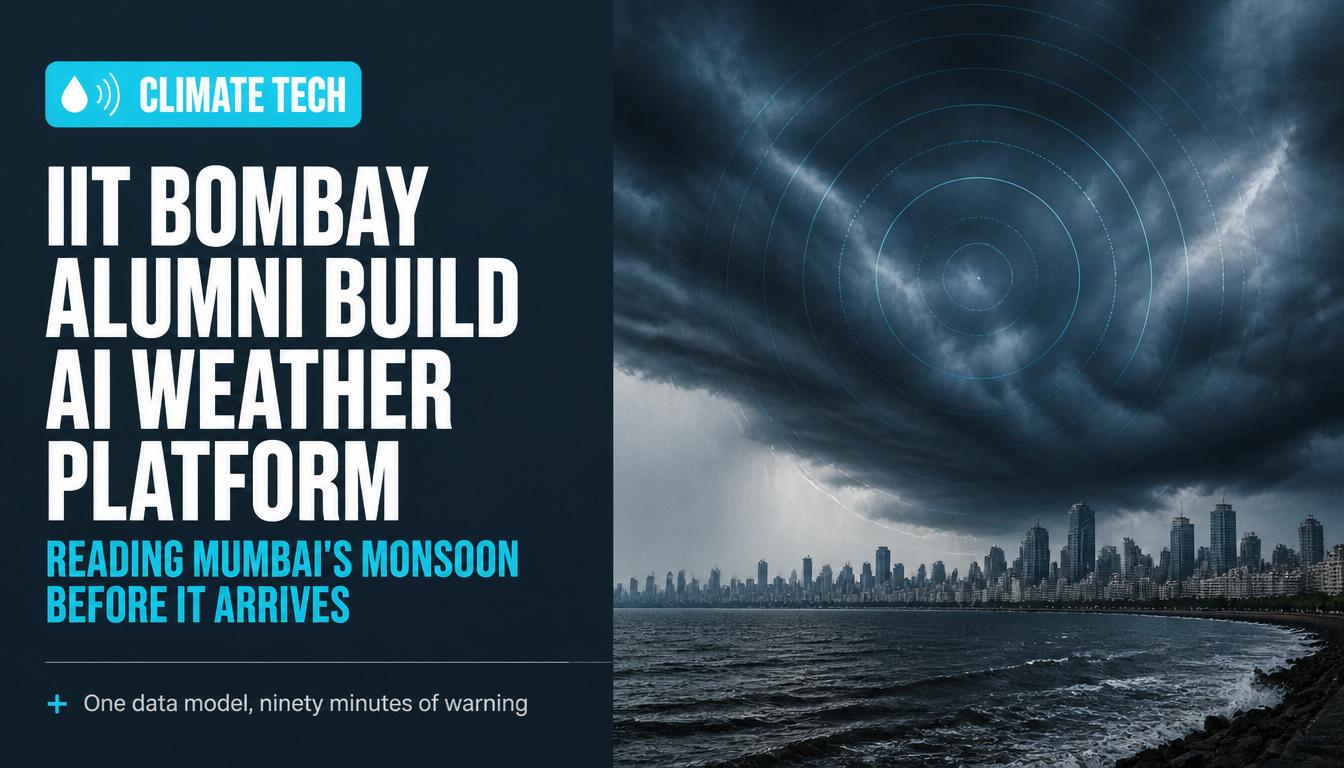
A platform called WeatherEx, built by IIT Bombay research alumni, wants to read Mumbai’s notoriously unpredictable monsoon earlier than ever, offering hyperlocal rainfall forecasts to residents while quietly hoping the city’s own civic authorities become its next paying customer.
Highlights:
- WeatherEx is an AI based weather platform built by a team including IIT Bombay research alumni
- Dr Akshay Sunil, a climate tech specialist, serves as vice president for WeatherEx at Experiqs Private Limited
- The platform began roughly two years ago, with founders publishing experimental Mumbai rainfall nowcasts before its formal launch
- A separate academic project led by the same researcher predicts rainfall up to 90 minutes ahead using IMD radar data
- WeatherEx hopes to partner with Mumbai’s civic body, though no formal agreement has been announced yet
Mumbai’s weather has a habit of making fools out of forecasts. Clear skies at noon can become flooded roads by evening, and the gap between the two is often measured in minutes rather than hours. A platform built by IIT Bombay research alumni is betting that gap can be caught earlier.
WeatherEx, an AI based weather intelligence platform, is positioning itself as a way to read Mumbai’s monsoon shifts before they become disruptions, offering customised forecasts and helping users interpret rainfall patterns, monsoon winds, and weather conditions across different local scales within the city.
The platform is built by Experiqs Private Limited, where Dr Akshay Sunil, an IIT Bombay research alumnus and climate tech specialist, serves as vice president for WeatherEx. By Sunil’s own account, the platform did not appear overnight. It began roughly two years ago, with Mumbai as its first focus, and its founders were reportedly publishing experimental Mumbai rainfall nowcasts publicly well before this more formal platform launch.
It is worth being precise about what WeatherEx actually is, and what it is not, since the coverage around its launch has been careful to draw a specific line. WeatherEx is a private, commercial platform, built by a company, not a public research institution or civic body offering a free public service.
As one report on the launch put it plainly, this is a private company seeking a municipal client, not a public interest project offering itself for free.
That distinction matters because there is a genuinely separate, parallel academic effort involving the same lead researcher that could easily be confused with WeatherEx if the two are not kept apart. An AI nowcasting model developed at IIT Bombay’s Centre for Climate Studies, led by Sunil during his post doctoral work, analyses IMD radar data to predict rainfall up to 90 minutes ahead, with updates refreshing every eight minutes. That academic model is being integrated directly with IMD radar systems at Mumbai’s Regional Meteorological Centre, a public sector integration entirely distinct from the commercial WeatherEx product Sunil now also helps run.
This is not the first time IIT Bombay has built weather technology for Mumbai either. A separate, earlier initiative, the Mumbai Flood App, was developed through the HDFC ERGO IIT Bombay Innovation Lab in partnership with Mumbai’s municipal corporation, drawing on data from IMD observatories in Colaba, Santacruz, and Marine Lines, alongside more than 60 automatic weather stations across the city. That app, focused specifically on real time flood and waterlogging alerts through nine water level monitoring stations, remains a public facing, civic partnership product, again distinct from WeatherEx’s commercial ambitions.
WeatherEx’s own developers have said they hope to work with the Brihanmumbai Municipal Corporation to improve preparedness ahead of heavy rainfall events, a partnership that would meaningfully expand the platform’s reach and civic credibility if it materialises. As of now, no formal agreement between WeatherEx and the municipal corporation has been announced.
According to the reporting on WeatherEx’s launch, the platform offers customised forecasts for Mumbai and helps users interpret monsoon winds, rainfall patterns, and weather conditions across different local scales, positioning itself as a hyperlocal complement to broader, city wide forecasting.
It is worth applying real scrutiny to what remains genuinely unclear at this stage, rather than treating a well produced product launch as settled proof of technical superiority. The coverage around WeatherEx’s debut does not yet answer some fairly basic questions any serious civic partnership would need resolved, chief among them how WeatherEx’s actual forecast skill compares against existing public systems Mumbai already relies on, including India’s broader flood forecasting infrastructure and the IMD’s own radar integrated nowcasting work that Sunil himself has separately helped build in an academic capacity.
There is also a reasonable question about incentive clarity. Sunil’s dual role, leading a public sector academic nowcasting project while simultaneously serving as vice president of a commercial platform pursuing the same municipal client relationship, is not unusual in applied climate science, where academic researchers frequently commercialise their work through affiliated companies. But it does mean any eventual BMC partnership decision deserves scrutiny on its technical merits specifically, rather than resting on the credibility Sunil’s academic IIT Bombay affiliation lends to the commercial pitch by association.
None of this undermines the genuine civic value of better hyperlocal weather forecasting for a city as flood vulnerable as Mumbai. Monsoon disruption is a real, recurring, and expensive problem, one that touches everything from train delays to public safety, and any technology that can reliably extend Mumbai’s warning window, even by twenty or thirty minutes, has genuine value. Whether WeatherEx is the platform that delivers that value at civic scale, or whether Mumbai’s existing public infrastructure, including the very academic nowcasting model its own vice president helped build, ultimately proves the more reliable and appropriately incentivised choice for a public safety partnership, is a question that will only be settled once WeatherEx’s forecast accuracy is tested transparently against the systems already in place, rather than judged on the strength of its launch coverage alone.