
Speed and discounts built India’s quick-commerce market. FirstClub’s fresh funding round tests whether quality positioning can survive in a sector where Blinkit and Zepto are the undisputed titans of the space , armed with the infrastructure, the user base, and the deep-pocketed capital to hunt down any winning idea and make it their own.
India’s quick-commerce sector built its early identity around a clock. Groceries in ten minutes. The model worked, and it worked at an enormous scale. But the ten-minute promise has now become the baseline. There has been a prioritizing shift among users regarding quality .
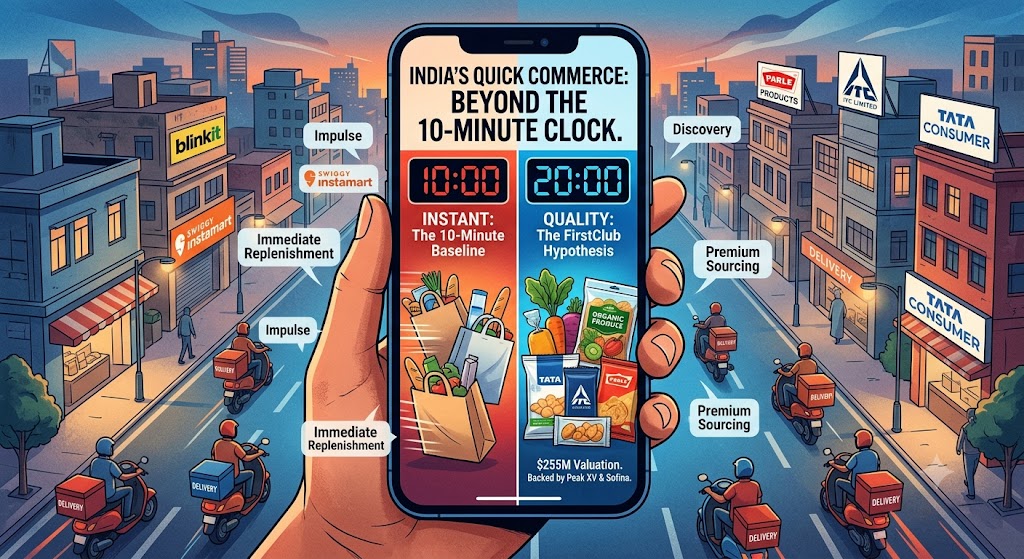
Into that contest comes FirstClub, a fresh, quality-prioritizing grocery startup founded by former Flipkart executive Ayyappan R. Backed by Peak XV and Sofina, the company recently raised a round at a $255 million valuation. Their pitch is that a segment of urban Indian consumers cares less about whether groceries arrive in ten minutes versus twenty, and more about what is actually in the bag. While this is a genuine hypothesis, how can one possibly defend such a structurally difficult position?
The market numbers give some context to the bet. The large companies such as ITC, Tata Consumer Products and Parle Products are seeing 60–75% of their online sales in quick commerce in FY26. Mayank Shah, Vice-President of Parle Products, said that one of the fastest growth trends in the retail segment is the preference of consumers towards convenience and immediate replenishment. The channel has come a long way from emergency purchases, and is redefining the way Indian households restock their daily needs.
The fact that Blinkit has become profitable, whereas Swiggy Instamart continues to burn cash has led investors to question the company and made unit economics more prominent than growth numbers in the industry. Bernstein is forecasting year on year growth of 75% for quick commerce in 2025, due to category growth outside of food and new city penetration. The growth curve is definitely interesting, but so are all of the surrounding formats that seem to have some consumer traction, and those big guys can certainly move in with the capital.
Devangshu Dutta, founder and CEO of retail consulting firm Third Eyesight, has described quick commerce advertising as retail media at its most concentrated where brands are not reaching consumers browsing online or walking through a store aisle, but intercepting them in a hyper contextual moment on a mobile screen. That compression of the purchase decision is exactly what makes the platform valuable to brands and exactly what makes premium positioning complicated. Impulse and quality discovery are not natural companions.
Samir Kumar (Amazon India Country Manager ) has said the company sees e-commerce as “still in its early days,” with quick commerce simply representing faster delivery within that continuum, adding that the company is “building this based on customer inputs” and believes “there will be multiple winners.” Amazon Now has since expanded beyond its Bengaluru pilot into Delhi-NCR, with industry estimates pointing to 300 dark stores across three major cities by end of 2025.
Premium positioning in retail becomes durable only when it is backed by something operationally difficult to copy: exclusive supply chains, proprietary sourcing, cold-chain infrastructure that takes years to build. Without those, the more likely outcome is not displacement of the incumbents , it is absorption by them.India’s quick-commerce sector has already answered the consumer question. Urban households use the format, and use it habitually. The harder, open question is whether quality can be a platform unto itself, or whether it becomes a feature that the platforms eventually roll into their existing offering. The funding suggests investors believe the former. The structure of the market suggests it will not be straightforward to prove.