
Indian AI Moves From Pilots to Deployment Across Government, SaaS and
Infrastructure
India’s AI story is quietly changing shape. The model launches and proof-of-concept
announcements are giving way to something more grounded and far more consequential: actual
deployment inside real institutions, real enterprises, and real infrastructure.
For a few years, the Indian AI story ran on a familiar script. A model launch, a government
partnership announcement, a pilot in a controlled setting, a round of funding, and then the long
quiet before anyone asked what actually shipped. That script is changing. Not dramatically, not
all at once, but in ways that are worth paying attention to.
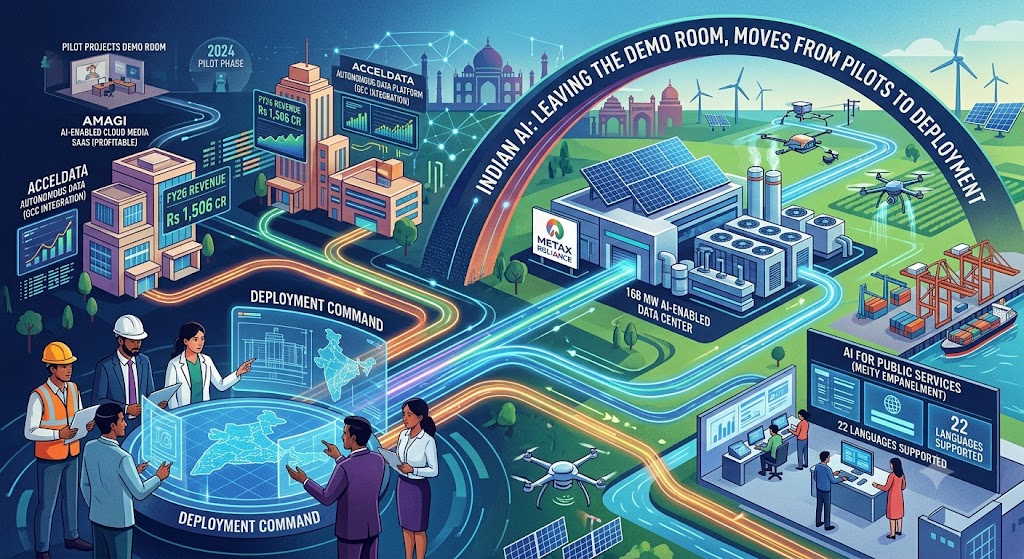
Four things happened in the last few weeks that, taken separately, each look like routine
industry news. Taken together, they mark a shift in where Indian AI actually lives now. The
Ministry of Electronics and Information Technology empanelled six companies to provide AI and
machine learning services across central ministries and government departments. Amagi, a
Bengaluru-based cloud media SaaS company, posted its first full year of profit. Acceldata
launched a platform targeting the unglamorous but load-bearing problem of enterprise data
fragmentation. And Reliance announced a 168 MW AI-enabled data centre in Jamnagar,
Gujarat, built to house Meta’s computer needs. These four stories do not share a surface. But
underneath each one is the same signal: Indian AI is being asked to perform, not just promise.
Start with the government empanelment, because that is where the scale and the complexity
both sit. MeitY, through the National e-Governance Division, ran a competitive process that drew
more than 80 bidders, including Deloitte, EY, PwC, Fractal Analytics, and KPMG. The six
companies that made the final cut are TCS, NEC Corporation India, Kyndryl Solutions, CoRover
(the company behind BharatGPT), Innefu Labs, and Cactus Technology Solutions. The
empanelment is valid for two years, with the possibility of an additional year. These companies
will now form a pre-approved vendor pool that central ministries, state departments, public
sector undertakings and affiliated organisations can draw from for AI-driven projects, without
having to run a fresh procurement process each time. That last part matters more than it
sounds. Procurement timelines in Indian government technology projects have historically been
one of the bigger bottlenecks to any kind of real deployment. The empanelment is an attempt to
reduce that friction. Innefu Labs emerged as the lowest bidder at Rs 40.67 lakh, with TCS at Rs
42.89 lakh and NEC India at Rs 48.98 lakh.
What is actually being asked of these companies is worth understanding carefully. Public sector
AI in India will not be solved by dropping a foundation model into a ministry and walking away.
The real work involves procurement workflows, access to clean government data, language
support for 22 official languages plus hundreds of dialects, accountability frameworks for
automated decisions that affect citizens, and the institutional patience to keep fixing things when
they break. Services companies and specialist AI vendors both have a role here. The winning
companies will not be the ones with the most impressive demos. They will be the ones that can
make AI work inside bureaucracies that were not designed for it.
Amagi’s results are a different kind of signal, but an important one for the Indian SaaS sector as
a whole. The company reported full-year revenue of Rs 1,506 crore for FY26, up 29.5% year on
year, and posted a profit after tax of Rs 72 crore, swinging from a loss of Rs 69 crore in the
previous year. Adjusted EBITDA rose more than sixfold to Rs 156 crore. Net Revenue Retention
came in at 125.9%, meaning existing customers are spending significantly more than they did a
year earlier, and the number of customers contributing more than one million dollars annually
grew from 28 to 35. CEO Baskar Subramanian described FY26 as the year the company began
validating the AI transition it had long anticipated for the media industry. The lesson for other
Indian SaaS companies is not that everyone needs to hit profitability immediately. It is that the
window for AI rhetoric without operating leverage is closing. Investors, customers, and public
markets are beginning to ask whether AI features actually improve retention, expand accounts,
or reduce delivery costs. Amagi’s numbers suggest that when the answer is yes, the economics
follow.
The Acceldata story is quieter but structurally important. The company launched what it calls an
Autonomous Data and AI Platform, designed for enterprises that are trying to deploy AI on top
of data estates that are scattered, inconsistent, and built across multiple incompatible platforms.
Research conducted ahead of the launch found that 80% of enterprises operate hybrid data
architectures, 75% manage four or more data platforms in production, and 40% named
governance fragmentation as their biggest cross-platform challenge. These are not abstract
problems. They are the reason so many enterprise AI projects stall between the pilot and the
deployment. An agent built on top of a data pipeline it cannot trust will produce outputs that
cannot be trusted either. Acceldata’s Bengaluru engineering teams are working with global
customers and their GCCs on exactly this problem. The GCC angle is worth dwelling on. Global
Capability Centres in India are no longer only back-office cost centres. They increasingly sit
inside the product, data, and AI workflows of their parent multinationals. If enterprise AI now
requires continuous engineering rather than one-time software installation, India’s depth of
enterprise technology talent becomes a structural advantage rather than just a cheaper
alternative.
Then there is Reliance and Meta, which is on a different scale entirely. The two companies
announced today that Reliance will build a 168 MW AI-enabled data centre in Jamnagar,
Gujarat, which Meta will lease. The facility will run on renewable energy and use desalinated
seawater for cooling, with Meta bearing the full cost of energy and water. It is India’s first
built-to-suit data centre for a global technology major of this scale, and it is being delivered
within two years. The Reliance-Meta relationship is not new. Meta invested $5.7 billion in Jio
Platforms in 2020, and the two companies have since built a joint venture developing enterprise
AI solutions using Meta’s Llama models for Indian businesses. But the Jamnagar data centre is
a different order of commitment. It connects AI to telecom, compute, renewable energy, and
physical infrastructure in a single structure. As AI models become more compute-intensive and
as India’s data centre capacity becomes a geopolitically significant asset, infrastructure strategy
and AI strategy are becoming the same thing.
Taken together, these four developments point to something real and something worth
questioning in equal measure. The real part is that India’s AI conversation has matured past the
demo stage. Ministries are hiring vendors. SaaS companies are posting profits on AI-enabled
products. Enterprise data infrastructure is being rebuilt for an agentic world. Global majors are
committing capital to Indian soil. The part worth questioning is the underlying distribution of
value. India could emerge from all of this as a large AI deployment market, a major provider of
AI-capable talent and services, and a host for global compute infrastructure, without capturing
the product economics and platform control that generate the most durable returns. Avoiding
that outcome requires something that remains thin: serious domestic product companies with
international scale, deep proprietary datasets, procurement reform that rewards innovation over
incumbency, and capital that understands how long deep technology cycles actually take.
The AI question in India used to be whether the country could build models competitive with
those coming out of San Francisco and Beijing. That question has not gone away, but it is no
longer the only one that matters. The question now is whether Indian companies can capture
enough value in the deployment layer, the infrastructure layer, and the software layer to build
something that compounds over time, rather than simply enabling others to do so at Indian
prices and Indian scale. That is harder to answer than a model benchmark. It is also the
question that will define the next decade.