
Andhra Pradesh Signs Deal To Become India’s First AI Powered Tourism State With NiVU AI Platform
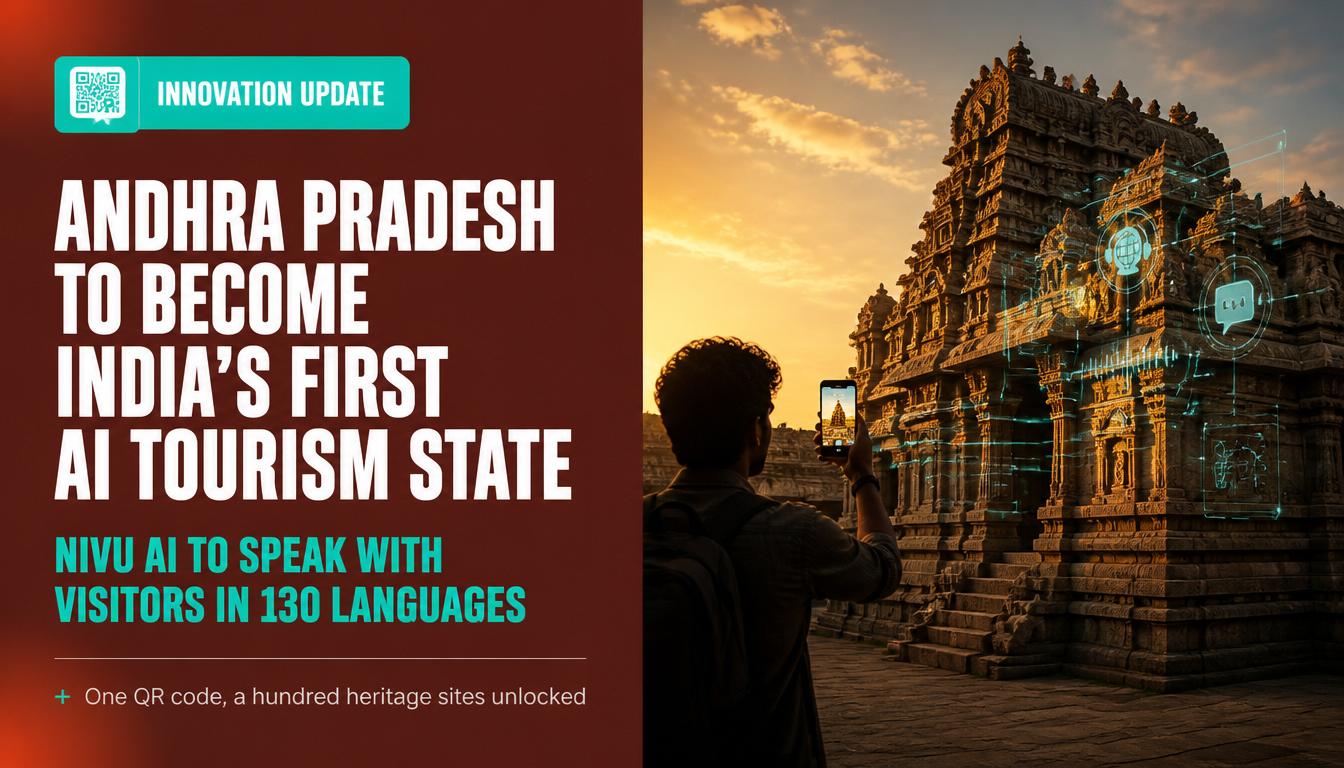
Andhra Pradesh has signed a three year deal to roll out an AI travel assistant across over 100 destinations, letting tourists speak with heritage sites in more than 130 languages through a simple QR code scan, no app required.
Highlights:
- Andhra Pradesh has signed a three year deal with travel tech firm Explurger to deploy NiVU AI
- The platform will roll out across more than 100 tourist and pilgrimage sites in phases
- Visitors can access the assistant by scanning a QR code, with no app download needed
- NiVU AI supports conversations in more than 130 languages through voice or text for free
- The rollout follows a pilot at Mangalagiri that the tourism minister says drew strong daily response
Standing in front of a centuries old temple or fort in India, most visitors face the same familiar limitation, a small plaque with a paragraph of text, perhaps a guide if they can find and afford one, and otherwise very little context for what they are actually looking at. Andhra Pradesh is now betting that a smartphone camera and an AI chatbot can fill that gap at scale. The state government has signed a three year strategic agreement with travel technology company Explurger to roll out an AI powered visitor assistant called NiVU AI across more than 100 tourist and pilgrimage destinations, a move officials say will make Andhra Pradesh the first state in India to be powered by artificial intelligence across its tourism circuit.
The announcement came from state tourism minister Kandula Durgesh, who oversaw the signing of the memorandum of understanding at the Secretariat, alongside special chief secretary Ajay Jain and senior officials from the Andhra Pradesh Tourism Authority. NiVU AI stands for neural intelligence vernacular unified model, and the pitch behind it is fairly straightforward even if the underlying technology is not, a visitor arrives at a heritage site, fort, beach, or cave, scans a QR code using their phone’s camera, and can immediately begin a conversation with an AI assistant about that specific location, all without downloading any app. The assistant is designed to work through voice or text, and Durgesh said it currently supports more than 130 languages, a range wide enough to cover both the bulk of India’s linguistic diversity and a meaningful share of international visitor languages as well.
The rollout is being planned in phases rather than all at once. The first phase will cover 30 major locations within the coming year, with the platform’s presence across the full target of over 100 destinations expected to be built out over the three year duration of the agreement, which can be extended further depending on how well the initiative performs. This phased structure suggests a degree of caution baked into an otherwise ambitious announcement, allowing the state and Explurger to iron out technical and logistical issues at a smaller scale before expanding to Andhra Pradesh’s full spread of heritage sites, many of which sit in more remote or less digitally connected parts of the state than a first look at the announcement might suggest.
Importantly, this is not a purely theoretical rollout being announced cold. The initiative follows what officials describe as a successful pilot project at Mangalagiri, a temple town that has reportedly already been receiving hundreds of visitor interactions with the NiVU AI platform daily. That existing usage data gives the state government at least some real world basis for its confidence, rather than relying purely on the promise of the technology in the abstract. Officials have also framed the initiative as more than a visitor convenience feature. Beyond enhancing the experience for tourists themselves, the platform is expected to feed real time analytics back to the Andhra Pradesh Tourism Authority on visitor preferences, language usage, and behavioural patterns, data that officials say could meaningfully improve how the state plans tourism infrastructure and manages individual destinations going forward.
The initiative sits within a much larger and more symbolically loaded framework for the state government, one it refers to as the Swarna Andhra Vision 2047, a long range development blueprint tied to India’s broader centenary of independence celebrations planned for that year. Durgesh described the AI tourism rollout as a genuinely historic step toward that vision, and struck an unusually personal note in describing his own experience testing the platform, saying he tried out NiVU AI in Telugu himself and found its responses both accurate and appropriately respectful, a small but deliberate detail meant to reassure the public that this is not simply an untested announcement riding on buzzwords. He also pointed to major recurring events like the Godavari Pushkaralu, a large scale religious gathering held periodically along the Godavari river, as an example of the kind of high volume tourist moment where an AI assistant capable of handling many languages at once could meaningfully ease pressure on human guides and staff.
Special chief secretary Ajay Jain framed the initiative in more explicitly aspirational, competitive terms, describing it as an attempt to position Andhra Pradesh as a model that other Indian states, and even other countries, might eventually look to as advanced AI technology becomes more accessible to everyday tourists rather than remaining confined to flagship, high budget applications. Tourism Authority chief executive Padmavathi described the partnership as a blend of the state’s rich cultural heritage with globally competitive Indian built technology. Explurger founder and chief executive Jitin Bhatia, whose company is providing the underlying platform, said the collaboration would let every major tourist destination in the state effectively speak to every visitor in their own language, a framing that captures the ambition behind the project fairly well even if it inevitably simplifies the harder technical and operational work still required to make that a reliable, everyday reality across more than 100 sites with wildly varying levels of connectivity, footfall, and staff support.
There are a handful of reasonable questions worth sitting with before treating this as an unambiguous success story. Claims of being the country’s first at anything are common in Indian state government communications, and are not independently verified against what other states may already be quietly piloting in similar spaces, so the first mover framing here should be read as the state’s own characterisation rather than an objectively confirmed fact. The technology itself also raises a familiar set of concerns that tend to follow any large language model deployed in front of the general public at scale, namely the risk of factual inaccuracies, hallucinated historical details, or culturally insensitive responses, especially at religiously significant pilgrimage sites where getting details wrong could cause genuine offence rather than mild embarrassment. The minister’s personal anecdote about testing the tool himself in Telugu is a reasonable data point, but it is inherently a small, informal sample rather than a rigorous, independently audited accuracy assessment across all 130 plus supported languages and the full range of historical and cultural content the system will need to handle correctly.
There is also a quieter, more structural question about digital access and connectivity. A system that depends entirely on visitors scanning a QR code with a working smartphone and a reasonably stable internet connection assumes a baseline of digital access that, while increasingly common across urban and semi urban India, is still not universal, particularly at some of the state’s more remote pilgrimage sites where mobile network coverage can be patchy at best. None of this means the initiative is not a genuinely interesting and potentially valuable use of AI in a public facing government service, one that could meaningfully improve the experience for millions of visitors if executed well. But the gap between an ambitious three year rollout plan announced at a signing ceremony and the reality of consistently reliable, multilingual, culturally sensitive AI performance across more than 100 diverse sites over several years is exactly the kind of gap that tends to separate genuinely transformative public technology projects from well intentioned announcements that quietly underdeliver. Andhra Pradesh has set itself an ambitious and genuinely novel target. Whether NiVU AI becomes a model other states study and replicate, or simply a headline grabbing pilot that struggles to scale past its first 30 locations, will depend far less on the announcement itself and much more on the unglamorous, difficult work of execution that now begins.