
How Equip Is Using AI to Change Company Hiring in 2026: Conversational Interviews, Skill Tests and Human-Led Decisions
Built by a physicist turned entrepreneur from Bengaluru, trusted by 700 teams across 80 countries, rated 4.8 on over 900 reviews. Equip is not the loudest name in AI hiring. It may be the most carefully constructed one.
Jayanth Neelakanta spent six years at Syracuse University studying theoretical and mathematical physics, writing a doctoral thesis that most people in the hiring technology industry would have no chance of understanding. It is a detail that has nothing to do with resume screening or conversational AI interviews, and yet it explains something important about the company he went on to build. A physicist who has spent years building careful models of the universe does not approach a messy, human problem like hiring with the same breezy confidence of someone who has simply noticed a large market and decided to build a SaaS product for it. He approaches it with an uncomfortable amount of attention to where the model breaks down.
Equip, the Bengaluru-based hiring platform Neelakanta founded in August 2020, reflects that disposition. It is not the most aggressively marketed name in India’s AI recruitment space. It does not have the most impressive funding round. What it has is a 4.8 rating across more than 900 reviews on G2, more than 700 hiring teams using it across 80 countries, a customer list that includes Practo, Treebo Hotels and Shadowfax, and a product that companies return to because it does exactly what it says it will do, quietly and without causing problems.
The company raised a $400,000 pre-seed round from Better Capital in September 2022, one of India’s most respected early-stage funds, founded by Vaibhav Domkundwar. That round was small by the standards of what AI hiring platforms in the US have raised, but it was the right capital at the right time from an investor who understood what Neelakanta was building and why the Indian market specifically needed it.
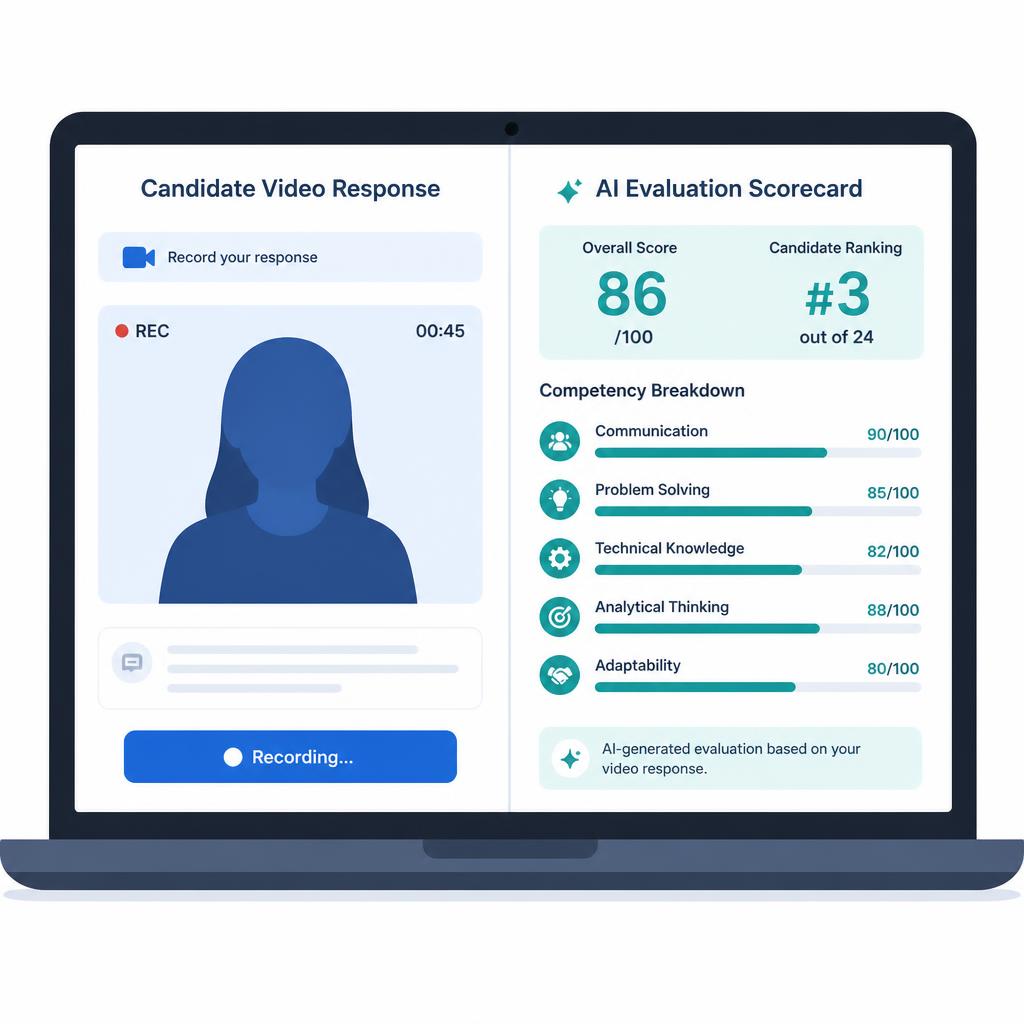
What Equip actually does is worth explaining in concrete terms, because the category of “AI hiring platform” has become so broad as to be nearly meaningless. At its core, the platform combines five things that are typically handled by separate tools: an AI-native applicant tracking system for intelligent candidate tracking, automated resume screening that uses natural language rather than keyword operators, asynchronous video interviews where candidates record responses to structured questions, live conversational AI interviews where the system holds an actual back-and-forth dialogue with a candidate and generates a detailed scorecard, and AI-powered proctoring that uses dual-device monitoring to maintain assessment integrity at scale. All of these live in a single platform, which matters more than it might seem. Companies that use five separate tools for five separate stages of hiring pay five separate vendor fees, maintain five separate data silos and spend real engineering and HR time managing integrations that were never designed to talk to each other cleanly.
The conversational AI interview capability deserves particular attention because it is where Equip most directly challenges the traditional interview process. Instead of a recruiter spending 20 minutes on a phone screen with 200 candidates one by one, Equip’s AI conducts those conversations at scale simultaneously. It asks role-specific questions set by the recruiter, evaluates responses across text, audio and video, asks natural follow-up questions and produces a structured scorecard. The recruiter gets a ranked list of candidates with interview transcripts and evaluations ready to review. They did not sit through any of those calls. They simply look at the output and decide who to take forward to the next stage.
“We want to equip recruiters with identifying great talent. Equip will not only help companies reduce the time and effort to hire, but also help them look beyond CVs and pedigree, and focus on candidates’ skills.”
Jayanth Neelakanta, Founder and CEO, Equip
The framing Neelakanta uses, of helping companies “look beyond CVs and pedigree,” is central to the product philosophy. India’s hiring market has historically been deeply credential-driven. A degree from an IIT or an IIM opened doors. A degree from a state university in a tier-2 city did not, even for a candidate with the skills to do the job. Skill-based assessments administered fairly and at scale have the potential to move hiring decisions toward demonstrated capability and away from proxy signals like institution name. That is not a trivial social outcome. It is one reason why platforms like Equip matter beyond their immediate commercial story.
The pricing model reinforces the accessibility argument. At approximately ₹1 per candidate, with no subscription and no annual contract, Equip is structured for the reality of how many Indian companies actually hire. A startup doing a single large campus hiring drive does not want to pay for a year-long enterprise licence for a tool they will use intensively for three months and then barely touch for nine. A growing logistics company running recurring operations hiring across multiple cities wants a cost that scales with actual usage, not a fixed overhead that does not flex with hiring volumes. The per-candidate model solves both of those problems simultaneously.
Customers who have publicly described their experience with the platform include Practo, the healthcare technology company, which has used Equip for technical recruitment, Treebo Hotels, which uses it for tech hiring across a hospitality business with distributed teams, and Shadowfax, the logistics startup, which built an operations team using Equip’s assessment tools for a non-technical hiring profile. The diversity of those use cases, across healthcare tech, hospitality and logistics operations, speaks to the platform’s adaptability beyond pure software engineering recruitment.
“We are making skill assessments 100 times easier with Equip and putting it everywhere it’s needed without forcing users to go on different workflows and journeys.”Vaibhav Domkundwar, Founder and CEO, Better Capital
The broader context in which Equip is operating makes the timing of its growth particularly significant. India’s staffing and recruitment market is projected to grow from $18.06 billion in 2022 to $48.53 billion by 2030, a compound annual growth rate of 13.2%. Over 92% of Indian companies now use some form of AI in their hiring processes. Hiring intent in India rose 11% year-on-year for 2026, driven by growth in AI roles, BFSI, manufacturing and infrastructure. Sixty percent of recruiters use AI for resume screening and 45% for interview automation. The demand for the kind of infrastructure Equip provides is not speculative. It is being expressed in purchasing decisions and budget allocations across a rapidly expanding market.
What Equip has done, that many of its noisier competitors have not, is build slowly and carefully enough to earn the trust of the people who use it. A 4.8 rating across 900 reviews is not the result of a marketing campaign. It is the result of a product that works, support that responds, and a business that does not overpromise. In a category where many AI hiring tools have generated headlines for bias lawsuits, opaque algorithms and discriminatory outcomes, Equip’s approach of keeping humans in the hiring decision while automating the evaluation labour has turned out to be not just ethically sensible but commercially smart.
Neelakanta’s company is at an interesting inflection point. The pre-seed from Better Capital gave it the resources to build the product. The 700-team customer base across 80 countries gives it the evidence base to raise a larger round if it chooses to. The question is whether a company that has grown carefully and deliberately will choose to accelerate, and whether the careful culture that made it trustworthy at small scale can survive the pressures of rapid growth. That is a question every well-built startup eventually has to answer. Equip has at least earned the right to ask it.